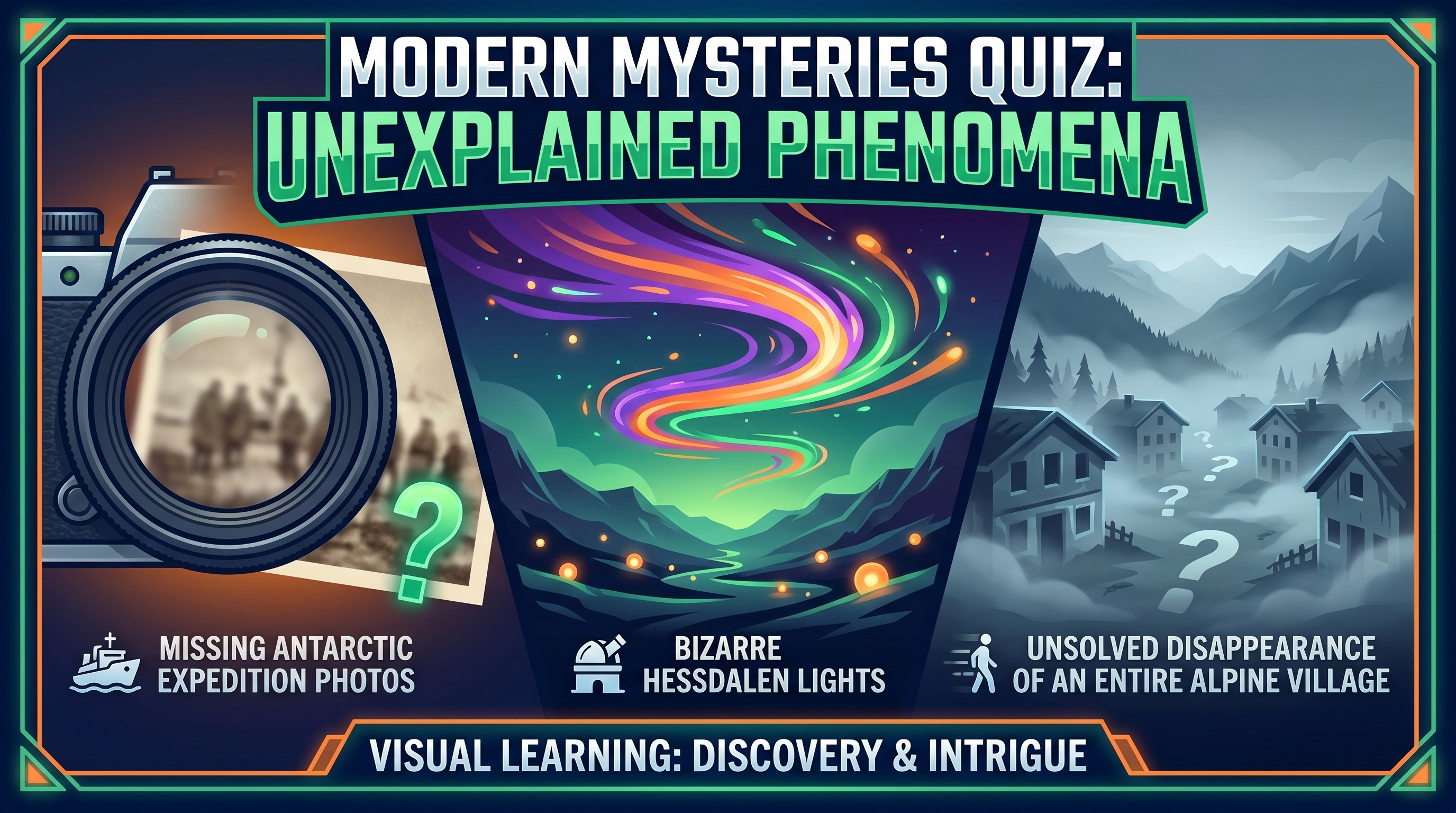
Unsolved Global Enigmas
About this quiz
Analytical study of historical anomalies.
What this quiz asks
- When analyzing the historical failure of early 20th-century Antarctic expeditions, which environmental factor most significantly hindered the preservation of physical artifacts and photographic records?
- In the context of the 'missing' Antarctic expedition photos, how does the concept of 'Polar Exploration Failures' categorize the loss of data due to logistical mismanagement versus environmental catastrophe?
- Which analytical framework best explains the recurring 'Polar Exploration Failures' where entire caches of photographic evidence vanish despite precise records of their burial locations?
- When synthesizing evidence regarding lost expedition photos, how does the interaction between material decay and environmental shifting redefine our understanding of 'Polar Exploration Failures'?
- The Hessdalen lights often exhibit a distinct oscillating movement. Which atmospheric phenomenon best explains the conversion of ionized gas into visible plasma in this specific valley environment?
- When analyzing the Hessdalen lights, researchers use spectral data to determine composition. Which spectral signature would confirm the presence of ionized metal vapor within these luminous phenomena?
- Considering the interaction between topography and air density in the Hessdalen valley, how do localized magnetic field fluctuations influence the longevity of these luminous phenomena?
- If a researcher observes a 'cold light' phenomenon in an alpine environment, how would they synthesize the data to distinguish between Atmospheric Luminous Phenomena and traditional combustion?
- When analyzing the sudden abandonment of a remote alpine village, which demographic indicator is most critical for establishing a baseline for population stability before a collapse?
- If an alpine village is found abandoned with intact personal belongings, which ecological or socio-economic theory best explains the phenomenon of 'sudden desertion'?
- How does the 'carrying capacity' model in Settlement Abandonment Theories account for the failure of high-altitude agricultural societies?
- When synthesizing multiple data sets to investigate an unsolved village disappearance, which combination of evidence provides the most robust hypothesis for abandonment?
- When analyzing the Hessdalen valley's geophysical anomaly patterns, which specific atmospheric condition is frequently cited as a potential catalyst for the localized, self-sustaining luminous phenomena?
- In the context of the mysterious disappearance of an entire alpine village, which geophysical anomaly pattern might explain sudden, large-scale ground instability that leaves no structural trace?
- Regarding the missing Antarctic expedition photos, how might localized magnetic field fluctuations influence the degradation of early film stock, creating the appearance of missing or 'erased' visual data?
- By synthesizing data from Hessdalen's luminous displays and polar magnetic anomalies, what common geophysical anomaly pattern emerges as a primary factor in these unexplained phenomena?
- In the analysis of potential evidence from a lost Antarctic expedition, which forensic technique is most critical for determining if a recovered photographic plate has suffered from chemical degradation versus intentional exposure?
- When investigating the Hessdalen lights, how do forensic scientists differentiate between genuine plasma-based atmospheric phenomena and sensor artifacts in digital imagery?
- In the case of a suddenly abandoned alpine village, which forensic approach would best determine if the departure was a rapid evacuation versus a slow, multi-year decline?
- To synthesize evidence from the three mysteries, which forensic protocol allows for the most rigorous validation of anomalous physical samples found at these disparate sites?
- When analyzing the socio-historical context of the 1920s Antarctic expeditions, which factor most significantly influenced the public's perception of missing photographic records?
- The persistent reports of the Hessdalen lights in Norway have been studied through various socio-historical lenses. How does the local community's cultural integration of these phenomena alter the scientific data collection process?
- Considering the disappearance of an entire alpine village, which socio-historical indicator would most strongly suggest that the event was a deliberate migration rather than a catastrophic mystery?
- When synthesizing the disappearance of an alpine village with the missing Antarctic photos, what shared socio-historical element explains the long-term persistence of these events as 'unsolved mysteries'?
Answer choices and explanations are shown when you take the quiz.
Topics
Polar Exploration FailuresAtmospheric Luminous PhenomenaSettlement Abandonment TheoriesGeophysical Anomaly PatternsForensic Evidence InterpretationSocio Historical Context Analysis
Make your own quiz free
Describe any idea in a sentence and Remee builds it for you — stories, games and
quizzes on whatever you or your class are working on. Free to start, no card needed,
and everything you make gets a link you can share anywhere.
Create a free accountSee it for classrooms
Quizzes on Remee
Remee quizzes come in six formats — including image questions, matching,
drag-and-drop and branching — and can be played live with up to 35 people at once,
which makes them work as easily in a classroom as they do on your own.
 Quiz
Quiz