Strategic Leadership Legacy
About this quiz
Analyzing pivotal executive decision-making.
What this quiz asks
- Arrange these foundational stages of a Crisis Governance Framework from the initial reaction to the long-term stabilization phase.
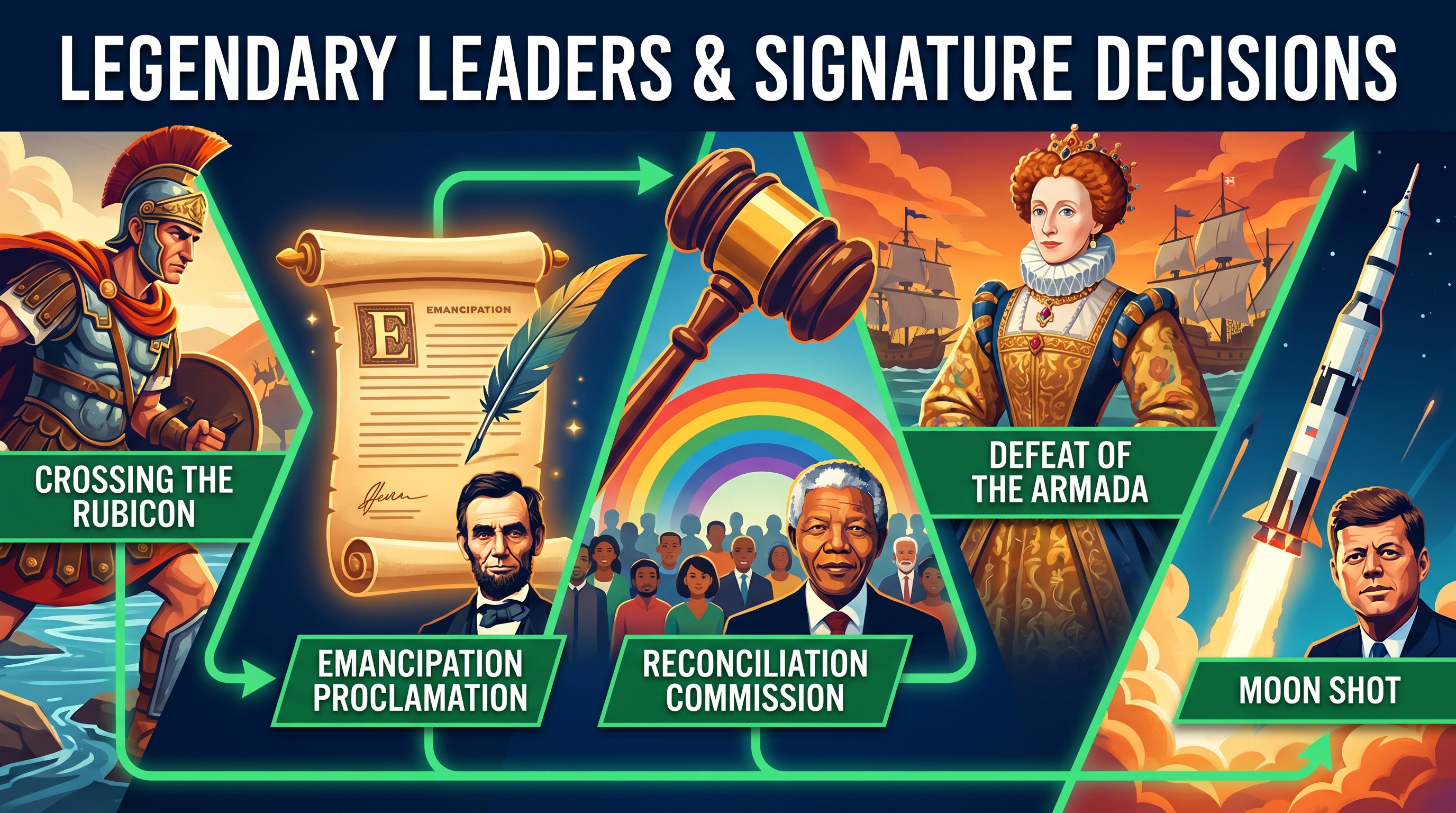
- Categorize these signature decisions by legendary leaders into the appropriate Crisis Governance Framework phase: 'Direct Containment' or 'Structural Reform'.
- Order the following components of a Crisis Governance Framework from the most 'Reactive' to the most 'Proactive' in terms of institutional intent.
- Align these legendary leadership decisions with the correct Crisis Governance Framework outcome they achieved.
- Arrange these historical leaders' signature geopolitical power projection strategies from the most localized territorial consolidation to the most expansive global maritime influence.
- Sort these leaders' signature decisions by the primary mechanism of their Geopolitical Power Projection, moving from 'Hard Power Military Coercion' to 'Soft Power Diplomatic Influence'.
- Order these leaders according to the scale of their geopolitical influence, from the most concentrated regional influence to the most widely distributed global impact.
- Arrange the following leaders based on their strategic decision-making timeline, from the establishment of initial frontier control to the maintenance of established global hegemony.
- Arrange these foundational Institutional Reform Strategies from the most centralized administrative control to the most decentralized local autonomy.
- Order the following phases of a successful Institutional Reform Strategy from the initial recognition of systemic failure to the final operational normalization.
- Rank these historical reform approaches from the least disruptive (incremental adjustment) to the most disruptive (radical structural transformation) based on the leader's signature decision.
- Sequence these stages of resource mobilization for an Institutional Reform Strategy, from the initial resource identification to the final sustainable self-financing model.
- Arrange these leaders in order of the historical sequence in which they implemented significant economic policy paradigm shifts, from earliest to most recent: 1. Alexander Hamilton (Financial Plan for Federal Assumption of State Debt), 2. Deng Xiaoping (Reform and Opening-up policy), 3. Margaret Thatcher (Privatization and deregulation of state-owned industries), 4. Franklin D. Roosevelt (New Deal interventionism).
- Categorize the following signature economic decisions by the primary Economic Policy Paradigm Shift they represent: Sort these into 'State-Led Intervention' or 'Market-Liberalization Strategy'.
- Rank these Economic Policy Paradigm Shifts by the scale of their initial market impact, from most transformative for global trade (1) to least transformative (4).
- Arrange the following leadership actions to reflect the logical progression of an Economic Policy Paradigm Shift from inception to institutionalization: 1. Theoretical justification (e.g., academic or advisory papers), 2. Legislative enactment (e.g., passage of major reform acts), 3. Bureaucratic implementation (e.g., creation of new regulatory agencies), 4. Cultural normalization (e.g., widespread public acceptance of the new economic reality).
- Categorize these historical leadership actions under the appropriate ethical framework in the context of Ethical Dilemmas in Autocracy: Sort the actions into 'Utilitarian Stability' (sacrificing individual rights for perceived collective order) or 'Moral Absolutism' (adhering to fundamental ethical principles regardless of systemic consequences).
- Arrange these autocratic decision-making models in order of increasing centralization of power, from 'Consultative Autocracy' (advising with councils) to 'Absolute Despotism' (total consolidation of authority).
- Order the following scenarios of 'Autocratic Succession and Ethical Transition' from the most stable to the most volatile, based on the risk of systemic collapse when transitioning power.
- Sort these leadership legacy outcomes based on the 'Ethical Cost of Autocracy' from the lowest historical impact on human welfare to the highest, considering long-term societal consequences.
- Arrange the following phases of Technocratic Innovation Scaling in the correct sequence, from initial conceptual framework to full-scale operational implementation.
- Categorize these leadership decisions by the primary mechanism used to achieve Technocratic Innovation Scaling, sorting them into 'Resource Centralization' or 'Decentralized Experimentation'.
- Rank these common barriers to Technocratic Innovation Scaling from the most immediate tactical hurdle to the most significant structural impediment.
- Arrange the following steps of a 'Technocratic Pivot' in the correct order, moving from the identification of an institutional failure to the final institutional transformation.
Answer choices and explanations are shown when you take the quiz.
Topics
Crisis Governance FrameworksGeopolitical Power ProjectionInstitutional Reform StrategiesEconomic Policy Paradigm ShiftsEthical Dilemmas in AutocracyTechnocratic Innovation Scaling
Make your own quiz free
Describe any idea in a sentence and Remee builds it for you — stories, games and
quizzes on whatever you or your class are working on. Free to start, no card needed,
and everything you make gets a link you can share anywhere.
Create a free accountSee it for classrooms
Quizzes on Remee
Remee quizzes come in six formats — including image questions, matching,
drag-and-drop and branching — and can be played live with up to 35 people at once,
which makes them work as easily in a classroom as they do on your own.
 Quiz
Quiz