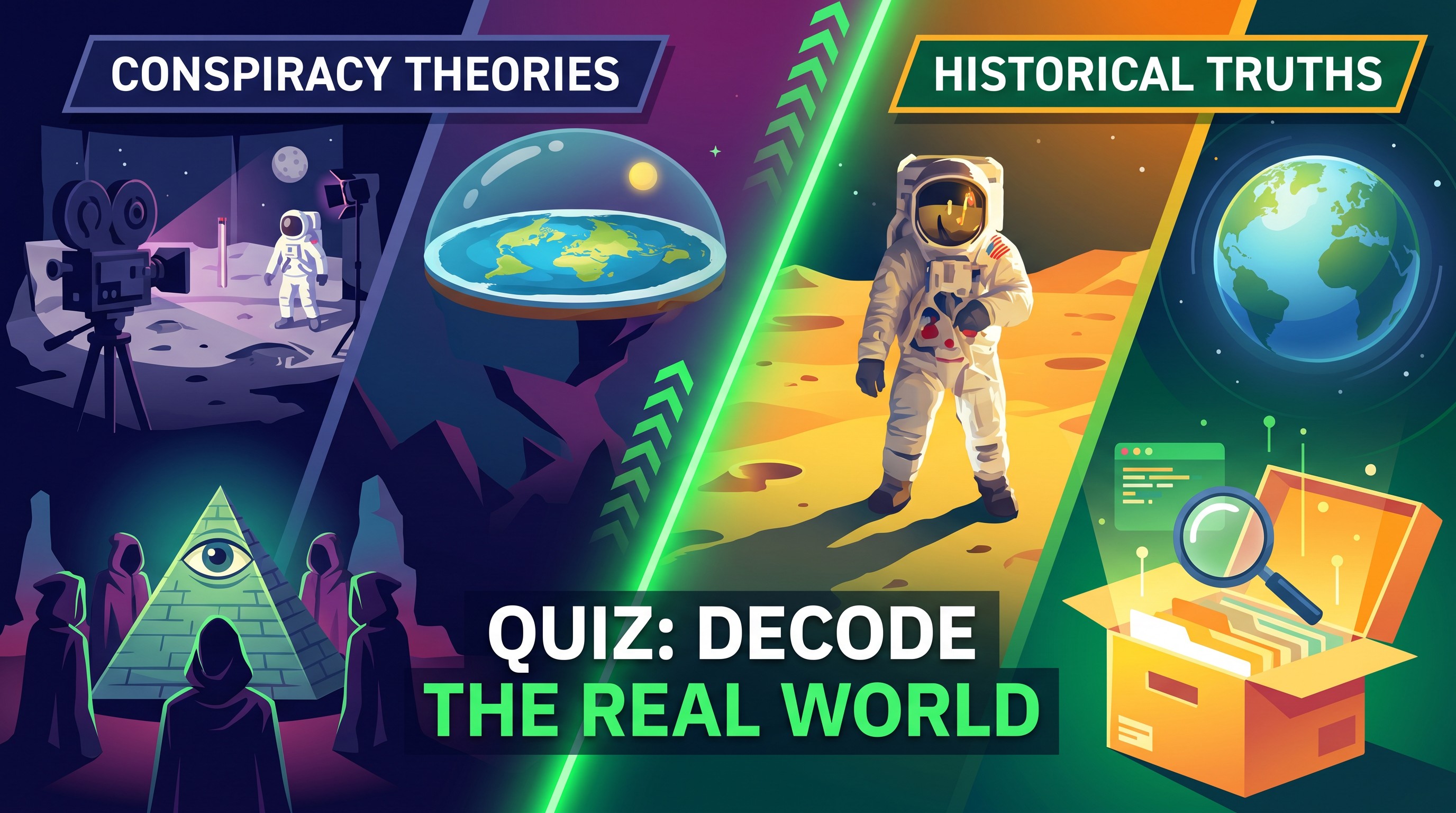
Conspiracies vs Reality
About this quiz
Fact-checking famous historical rumors
What this quiz asks
- A conspiracy is a secret plan by a group to do something harmful or illegal. Categorize these actions into 'Conspiracy' or 'Not a Conspiracy' based on this definition.
- To understand the Definition of Conspiracy, we must identify the components of a group plot. Arrange these components from the initial stage to the final outcome.
- Not every secret group is a conspiracy. Categorize these scenarios based on whether they fit the 'Definition of Conspiracy' (harmful/illegal intent) or are simply 'Private Groups'.
- Apply the Definition of Conspiracy to these situations. Rank them from most likely to be a true conspiracy to least likely based on the criteria of secrecy, group coordination, and harmful intent.
- When evaluating claims, place these steps in the correct logical order for verifying evidence, starting from the first action.
- Categorize these types of information into 'Evidence' (verified facts) and 'Speculation' (unproven claims) to help analyze potential conspiracies.
- Rank these sources of information from the most reliable (1) to the least reliable (4) for verifying a historical claim.
- Sort these actions into 'Verification' (checking facts) or 'Confirmation Bias' (seeking only what you already believe) to master the Evidence and Verification concept.
- Arrange these steps in the process of light reflecting off the Moon's surface from the perspective of an astronaut on the lunar surface, moving from the Sun to the observer's eye.
- Categorize these lunar features into two groups based on whether they were primary evidence collected by Apollo missions or if they are common myths used to argue against the landings.
- Order these events of the Apollo 11 mission from the earliest stage to the final stage of the lunar landing sequence.
- Arrange these scientific observations from the most easily verified by an amateur astronomer to the most complex, requiring advanced lunar laser ranging equipment.
- Categorize these claims about historical events into 'Verified Historical Facts' or 'Commonly Debunked Myths' to understand how we separate truth from fiction.
- Arrange these steps in the correct order for investigating a 'Historical Event Myth' from the initial claim to the final conclusion.
- Sort the following historical myths and their corresponding scientific or logical explanations to show how we debunk false narratives.
- Order these events from the most widely believed myth to the least controversial historical fact to understand how misinformation spreads.
- Categorize these media sources based on their typical role in Public Perception and Media. Drag each source into the zone of 'Primary Information Source' or 'Opinion and Analysis'.
- Arrange these steps in the correct order for Analyzing Misinformation when you encounter a sensational claim in the media.
- Order these types of media influence from the most objective (fact-based) to the most subjective (opinion-based) to better understand Public Perception and Media.
- Drag these actions into the correct sequence to show how a rumor transforms into a widely accepted conspiracy theory in the public eye.
- Categorize these information sources based on their reliability for Analyzing Misinformation: drag them into either 'Reliable Primary Sources' or 'Unverified/Opinion Sources'.
- Arrange the steps for Analyzing Misinformation from the first action to the final conclusion when investigating a suspicious claim.
- Order these types of digital content from most objective to most subjective when Analyzing Misinformation.
- Drag the following red flags of misinformation into the order of how quickly they should be noticed when Analyzing Misinformation (from most obvious to most subtle).
Answer choices and explanations are shown when you take the quiz.
Topics
Definition of ConspiracyEvidence and VerificationThe Moon Landing TruthsHistorical Event MythsPublic Perception and MediaAnalyzing Misinformation
Make your own quiz free
Describe any idea in a sentence and Remee builds it for you — stories, games and
quizzes on whatever you or your class are working on. Free to start, no card needed,
and everything you make gets a link you can share anywhere.
Create a free accountSee it for classrooms
Quizzes on Remee
Remee quizzes come in six formats — including image questions, matching,
drag-and-drop and branching — and can be played live with up to 35 people at once,
which makes them work as easily in a classroom as they do on your own.
 Quiz
Quiz