Cinematic Visual Language
About this quiz
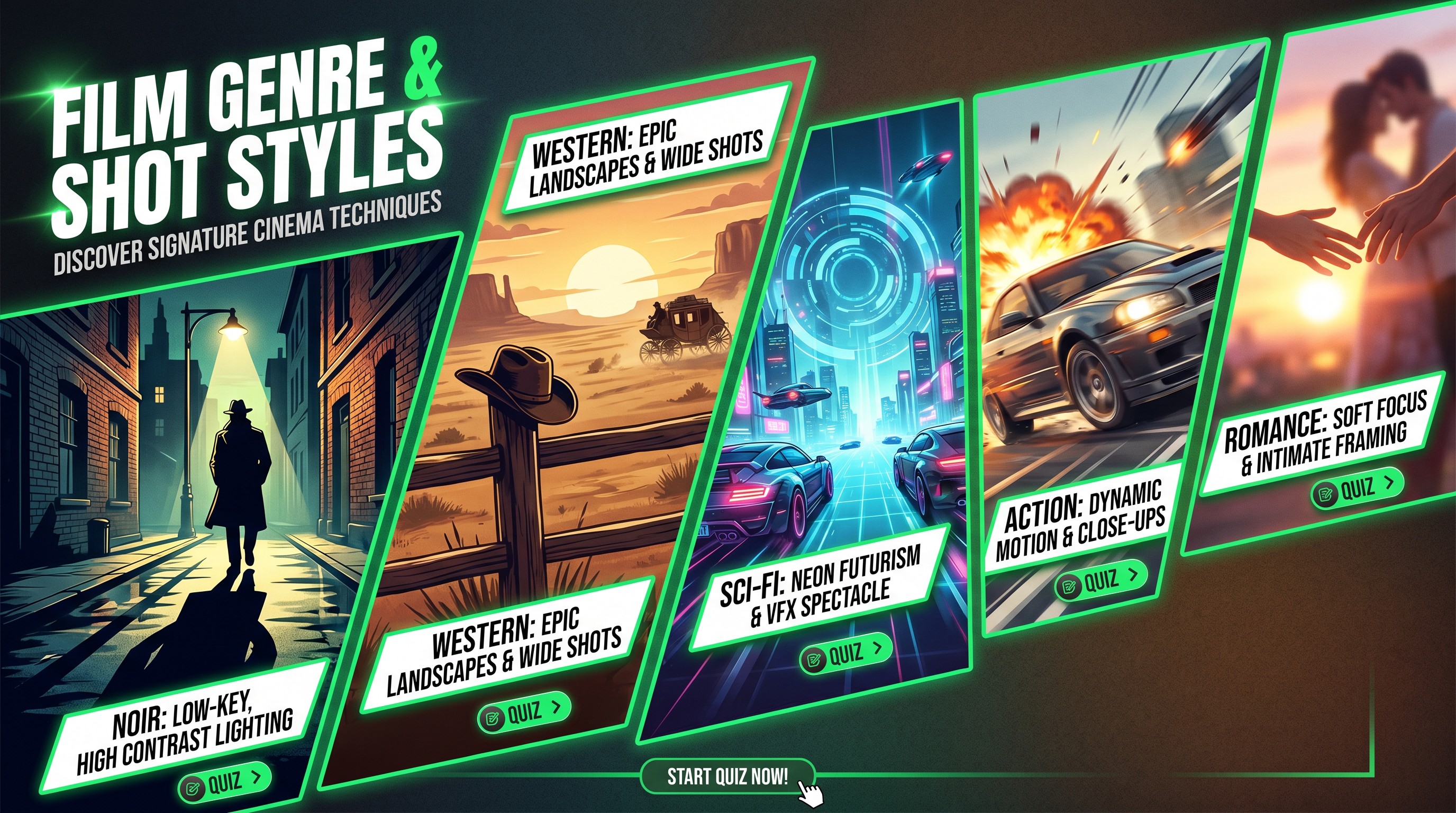
Analyzing genre-specific camera techniques
What this quiz asks
- Arrange these visual elements from the most commonly associated with Noir Chiaroscuro Lighting to the least associated in classic cinema.
- Categorize these lighting techniques into those that support the Noir Chiaroscuro Lighting style and those that typically belong to other cinematic genres.
- Order the following compositional steps used to achieve the Noir Chiaroscuro Lighting effect from the initial setup to the final aesthetic refinement.
- Rank these scenes by the intensity of Noir Chiaroscuro Lighting, from the most extreme contrast to the least.
- Western Wide Landscape Framing often emphasizes the isolation of the individual against the vastness of the frontier. Arrange these classic elements of a Western landscape shot from the most intimate (closest to the subject) to the most expansive (widest focus on the environment).
- Western Wide Landscape Framing utilizes depth to tell a story about the protagonist's journey. Order these compositional elements from the foreground (closest to the camera) to the background (deepest part of the image).
- The aesthetic of Western Wide Landscape Framing is defined by how the camera captures the horizon. Arrange these shots from the lowest camera angle (closest to the ground) to the highest camera angle (looking down from a vantage point).
- Western Wide Landscape Framing often incorporates specific environmental textures to establish mood. Order these items from the least complex texture (smoothest surface) to the most complex texture (roughest surface) commonly found in these films.
- Categorize these visual elements based on their primary function within the Horror Subjective POV Shots concept: identify which elements serve to establish the 'threat's perspective' versus those that emphasize the 'victim's vulnerability'.
- Arrange these cinematic techniques in the logical sequence of a 'stalk-and-reveal' sequence using Horror Subjective POV Shots, from the initial unseen presence to the climactic realization.
- Categorize the following camera behaviors by how they manipulate the viewer's psychological state within the Horror Subjective POV Shots concept: 'Disorientation' vs 'Heightened Anticipation'.
- Arrange the following stages of a 'horror revelation' in the order they utilize Horror Subjective POV Shots to build narrative tension, from the least revealed to the fully revealed.
- Arrange these action film camera techniques from the most stable (least kinetic) to the most chaotic (highest kinetic handheld motion) to understand the evolution of Action Kinetic Handheld Motion.
- Categorize these specific visual characteristics into their appropriate zones based on the requirements for Action Kinetic Handheld Motion versus standard cinematography.
- Order the following stages of a high-intensity action sequence that utilizes Action Kinetic Handheld Motion to build narrative tension, from the initial setup to the climax.
- Sort these technical camera settings and gear choices into their correct impact on achieving Action Kinetic Handheld Motion.
- Arrange the following Sci-Fi Speculative Framing techniques from the most basic establishing shot to the most complex abstract perspective used to convey an alien environment.
- Categorize these visual elements based on whether they serve to ground the viewer in a 'Dystopian Urban' or 'Ethereal Celestial' Sci-Fi Speculative Framing style.
- Sequence these shots from the most 'human-centric' to the most 'alien-centric' framing techniques used in Sci-Fi Speculative Framing.
- Order these narrative-framing functions from the most 'descriptive' (establishing the world) to the most 'thematic' (questioning existence) within Sci-Fi Speculative Framing.
- In the study of Melodrama Close-up Intimacy, arrange these emotional intensity levels from lowest to highest as typically captured by tightening the frame on a character's face.
- Categorize these specific framing techniques into their primary functional roles within the genre of Melodrama Close-up Intimacy.
- Arrange the following steps in the typical 'Melodrama Close-up Intimacy' sequence that directors use to transition from external social order to internal emotional collapse.
- Sort these cinematic elements by their contribution to Melodrama Close-up Intimacy: categorize them as either 'Structural Elements' (the environment) or 'Affective Elements' (the emotional focus).
Answer choices and explanations are shown when you take the quiz.
Topics
Noir Chiaroscuro LightingWestern Wide Landscape FramingHorror Subjective POV ShotsAction Kinetic Handheld MotionSci Fi Speculative FramingMelodrama Close up Intimacy
Make your own quiz free
Describe any idea in a sentence and Remee builds it for you — stories, games and
quizzes on whatever you or your class are working on. Free to start, no card needed,
and everything you make gets a link you can share anywhere.
Create a free accountSee it for classrooms
Quizzes on Remee
Remee quizzes come in six formats — including image questions, matching,
drag-and-drop and branching — and can be played live with up to 35 people at once,
which makes them work as easily in a classroom as they do on your own.
 Quiz
Quiz