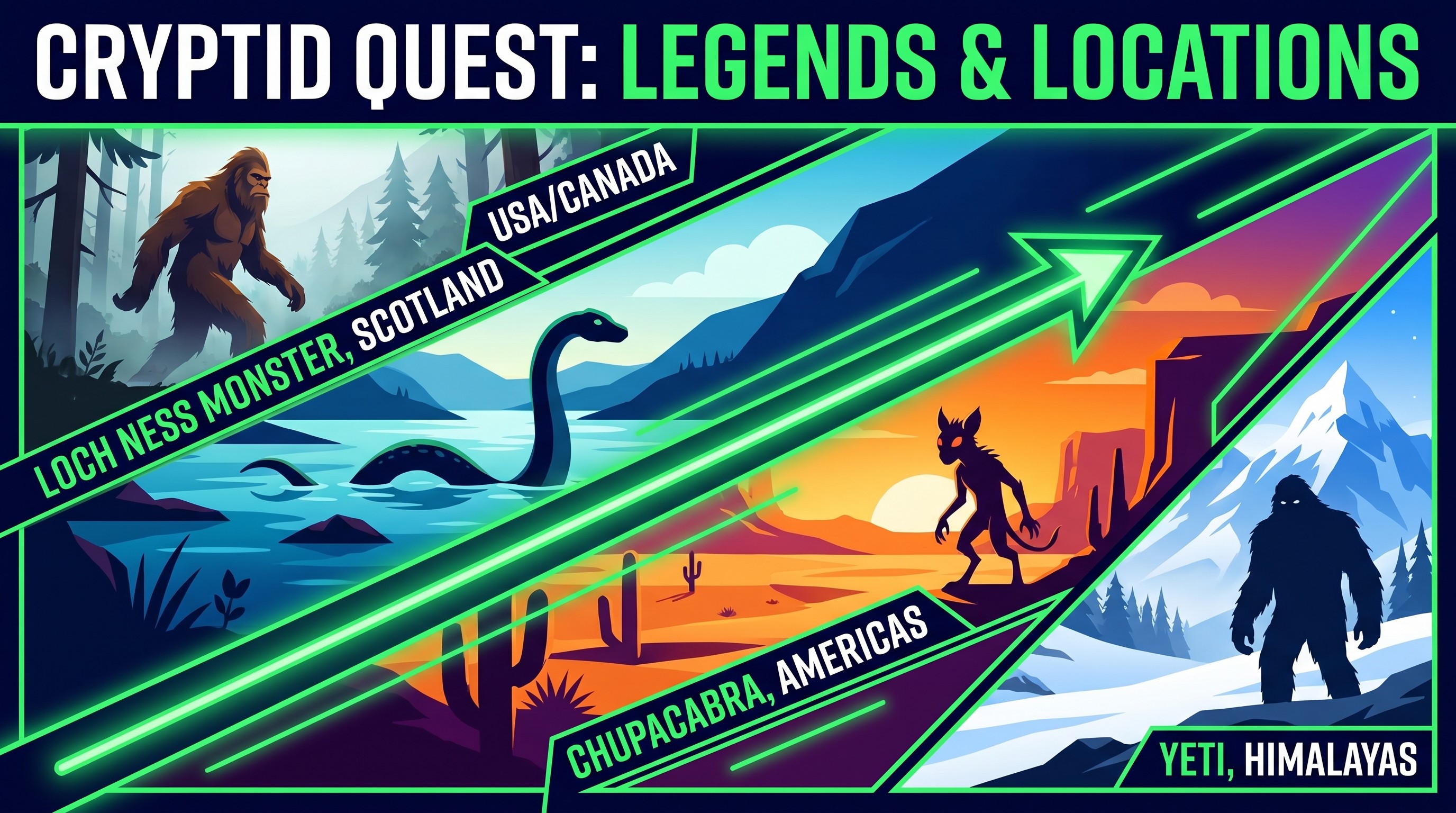
Global Cryptid Chronicles
About this quiz
Explore legendary creatures by region.
What this quiz asks
- Categorize these North American cryptids by their reported primary environment: Drag the cryptid names into the 'Forest/Mountain' zone or the 'Water/Lake' zone.
- Order these North American cryptids by their reported size from smallest to largest: 1. Smallest to 4. Largest.
- Drag the cryptids to match the specific North American region where their legend originated: 1. Pacific Northwest, 2. Eastern Seaboard, 3. Great Lakes, 4. Southwestern Desert.
- Arrange these North American cryptid sightings by the general era of their most popular cultural emergence, from oldest (1) to most recent (4).
- European Mythical Beasts often have distinct regional roots. Drag these creatures into their corresponding country of origin categories.
- Arrange these European Mythical Beasts from the creature most associated with aquatic environments to the one most associated with land-based mountain habitats.
- Drag these legendary European creatures into the correct sequence based on the historical era they first appeared in written folklore, from oldest (earliest) to most recent.
- Categorize these European Mythical Beasts based on their reported primary physical traits: 'Hybrid' (multiple animal parts) versus 'Humanoid' (resembling humans).
- Drag the following Asian cryptids into their correct country of origin: Japan or Vietnam.
- Arrange these Asian cryptids from the most aquatic habitat to the most terrestrial (land-dwelling) habitat.
- Match the following Asian cryptids with the specific natural environment they are traditionally said to inhabit.
- Order these cryptid reports by their reported size from smallest to largest.
- Drag these African cryptids into their correct country of origin, from North to South.
- Categorize these African creatures based on their primary environment: Water-dwelling or Land-dwelling.
- Arrange these African cryptid legends from the most commonly reported size (largest) to the least commonly reported size (smallest).
- Drag the cryptid to the region where its cultural origin is most strongly documented.
- Categorize these South American cryptids by their primary legendary environment: Sort them into the 'Aquatic' or 'Terrestrial' zones.
- Arrange these South American cryptids from the most northern country of origin to the most southern country of origin.
- Drag the cryptids into the correct category based on their legendary threat level: 'Harmless/Trickster' or 'Malevolent/Dangerous'.
- Sequence these cryptids based on the primary element associated with their folklore origins: 1. Air/Sound, 2. Earth, 3. Water, 4. Human/Transformation.
- Categorize these Oceanic Mystery Creatures by their primary reported habitat zone: Coastal/Shallow Waters vs. Deep Ocean/Open Sea.
- Arrange these Oceanic Mystery Creatures by their reported average size, from smallest to largest.
- Order these Oceanic Mystery Creatures based on their primary cultural role, from 'Protector/Guardian' to 'Aggressive Predator'.
- Sequence these creatures by the depth of their primary habitat, from surface-level to deepest abyss.
Answer choices and explanations are shown when you take the quiz.
Topics
North American FolkloreEuropean Mythical BeastsAsian CryptozoologyAfrican Cryptid OriginsSouth American LegendsOceanic Mystery Creatures
Make your own quiz free
Describe any idea in a sentence and Remee builds it for you — stories, games and
quizzes on whatever you or your class are working on. Free to start, no card needed,
and everything you make gets a link you can share anywhere.
Create a free accountSee it for classrooms
Quizzes on Remee
Remee quizzes come in six formats — including image questions, matching,
drag-and-drop and branching — and can be played live with up to 35 people at once,
which makes them work as easily in a classroom as they do on your own.
 Quiz
Quiz