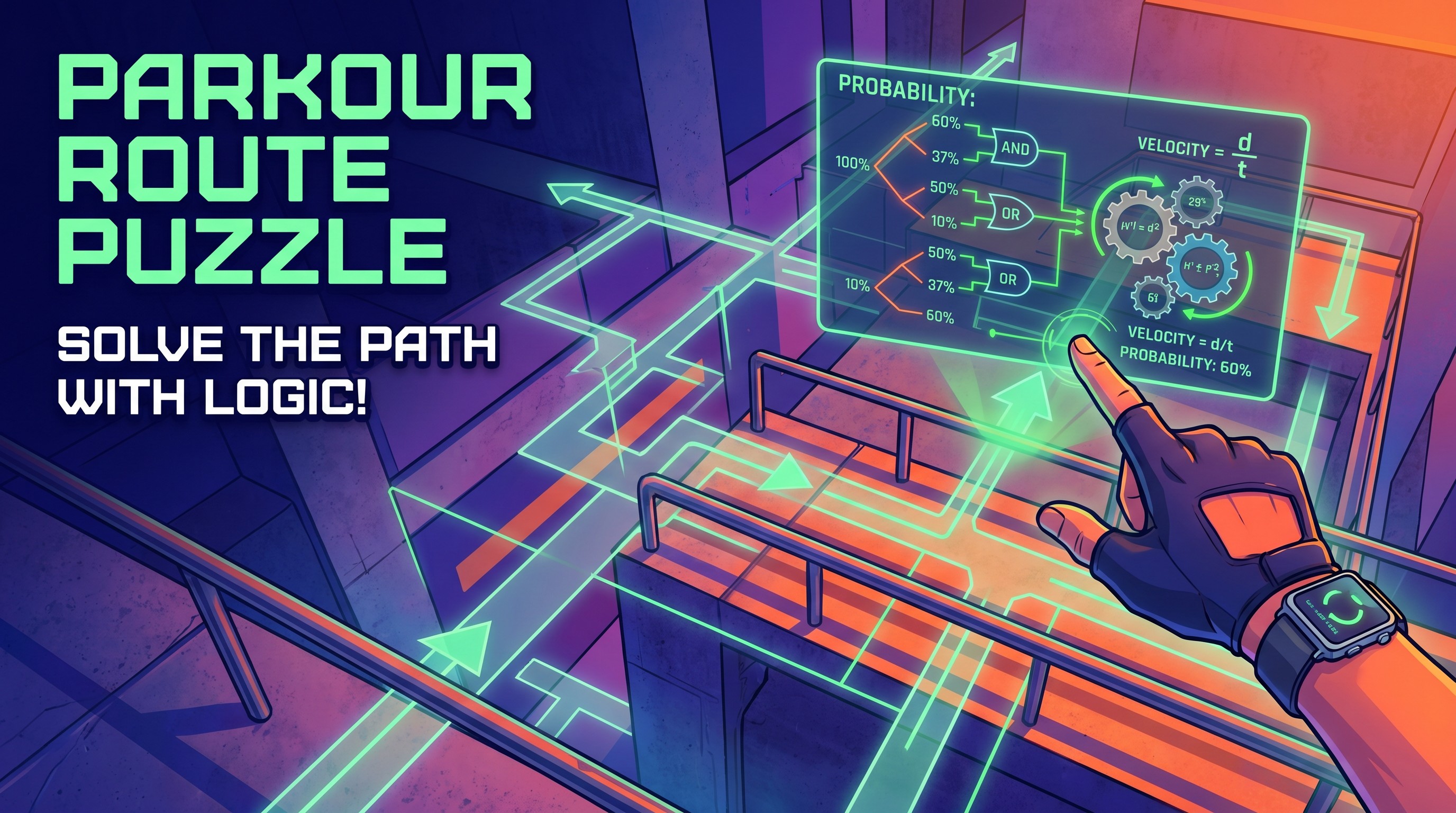
Parkour Path Logic
About this quiz
Master movement through math and probability
What this quiz asks
- A traceur jumps from a ledge and lands at a position represented by vector A = (3, 4) meters. If their next jump is represented by vector B = (2, 1) meters, what is the total displacement vector from the starting point?
- A parkour athlete moves along a wall with displacement vector V₁ = (6, -2) m. They then change direction with vector V₂ = (-4, 5) m. What is the net displacement vector?
- A parkour jump path is defined by vector P = (10, 8) m. If the athlete realizes they overshot and needs to adjust by vector A = (-3, -2) m, what is the final corrected displacement vector?
- A parkour route consists of three segments: V₁ = (2, 5), V₂ = (4, -1), and V₃ = (-1, 2). What is the resultant displacement vector for the entire route?
- To land a jump safely on a flat surface, the angle of impact θ must be minimized. If your trajectory angle is 30° relative to the horizontal, what is the landing angle relative to the vertical surface?
- If a traceur approaches a ledge and their landing force vector is split into horizontal (x) and vertical (y) components where x=4 and y=3, what is the resultant impact angle θ? Use tan(θ) = y/x.
- To optimize landing, you need to land such that the impact angle is within the 'safe zone' defined by 20° ≤ θ ≤ 40°. Which of the following calculated landing angles are safe?
- You are jumping from a height where your landing velocity v_y is 5 m/s and your horizontal velocity v_x is 5 m/s. What is the impact angle θ? Note: θ = arctan(v_y / v_x).
- A traceur weighs 60 kg and moves at 4 m/s. What is their momentum (p = mv)?
- If a parkour athlete increases their velocity from 2 m/s to 6 m/s while maintaining a constant mass, how does the momentum ratio change?
- Two athletes have a momentum ratio of 1:2. If athlete A has mass 50 kg and velocity 4 m/s, what is athlete B's momentum?
- To maintain a constant momentum of 300 kg·m/s, if an athlete's mass increases from 60 kg to 75 kg, what must their new velocity be?
- A traceur faces a decision tree with 3 starting paths. Path A leads to 2 sub-paths, Path B leads to 3, and Path C leads to 1. How many total potential route endings exist?
- A parkour course has a binary decision tree. Each decision point splits into 2 choices. If the route lasts for 4 consecutive decisions, how many possible paths exist?
- A route has 3 stages. Stage 1 has 3 options, Stage 2 has 2 options, and Stage 3 has 4 options. How many total unique paths can be formed?
- A route planner blocks 2 of the 10 available paths in a 3-level tree where each level doubles choices. If 16 paths existed originally, how many remain?
- A parkour athlete has a 70% probability of landing a specific jump successfully. If they attempt this jump 3 times in a row, what is the probability that all 3 jumps are successful?
- An athlete chooses between two routes. Route A has a 20% risk of injury, and Route B has a 1/6 risk of injury. Which route is statistically safer?
- If the probability of failing a vault is 0.15, what is the probability of failing at least once in 2 attempts?
- An athlete faces a jump where the probability of success is 'p'. If the probability of success over 2 attempts is 0.64, what is 'p'?
- A traceur weighs 60 kg and runs at 5 m/s. Calculate their kinetic energy using KE = 0.5 × m × v². What is the total kinetic energy in Joules?
- If a parkour athlete doubles their velocity from 4 m/s to 8 m/s, by what factor does their kinetic energy increase? Use KE = 0.5 × m × v².
- A traceur performs a jump requiring 1200 J of energy. If they have 800 J of kinetic energy and 500 J of potential energy stored, do they succeed?
- Find the velocity required to achieve 2000 J of energy for a 40 kg mass. Use v = √(2 × KE / m).
Answer choices and explanations are shown when you take the quiz.
Topics
Vector Displacement BasicsGeometric Landing AnglesMomentum and Velocity RatiosPathfinding Decision TreesRisk Assessment ProbabilityKinetic Energy Optimization
Make your own quiz free
Describe any idea in a sentence and Remee builds it for you — stories, games and
quizzes on whatever you or your class are working on. Free to start, no card needed,
and everything you make gets a link you can share anywhere.
Create a free accountSee it for classrooms
Quizzes on Remee
Remee quizzes come in six formats — including image questions, matching,
drag-and-drop and branching — and can be played live with up to 35 people at once,
which makes them work as easily in a classroom as they do on your own.
 Quiz
Quiz