Future Skies
About this quiz
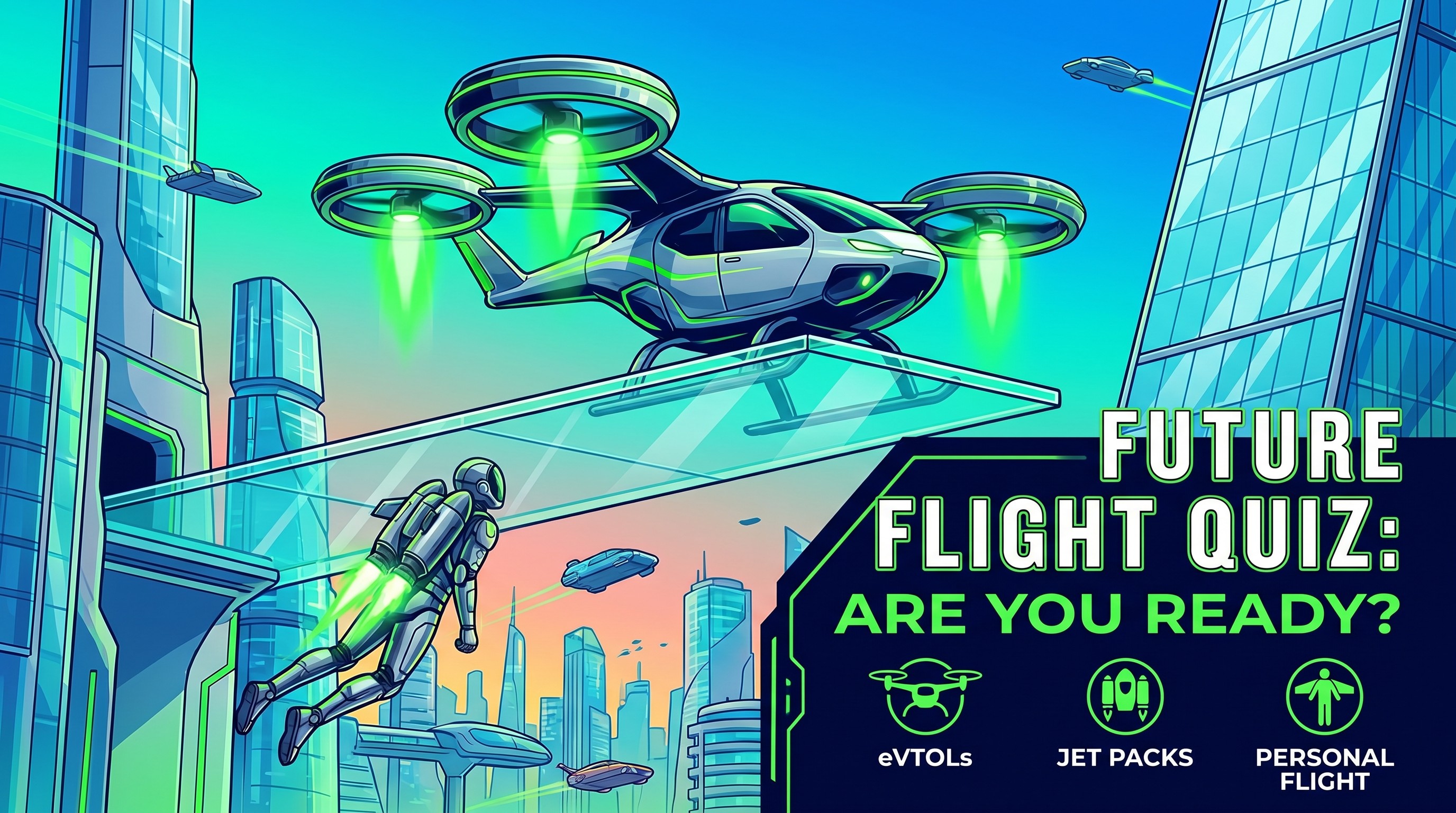
Exploring personal flight and eVTOL tech.
What this quiz asks
- When an eVTOL takes off vertically, which force must be greater than gravity to lift the vehicle off the ground?
- How does the shape of an eVTOL rotor blade help generate Aerodynamic Lift as it spins through the air?
- If an eVTOL transitions from vertical hovering to horizontal flight, what happens to the Aerodynamic Lift provided by the wings?
- Why must an eVTOL pilot adjust the angle of the rotor blades during flight to maintain consistent Aerodynamic Lift?
- In electric propulsion systems for flight, which component is primarily responsible for converting stored battery energy into physical motion to turn the rotors?
- When comparing electric propulsion to traditional jet engines, which property of electric motors allows them to be placed in multiple locations across an aircraft frame for better control?
- If an electric flight system needs to double its thrust, why can't the pilot simply add twice as many batteries without considering the aircraft's total weight?
- Which design choice best utilizes Electric Propulsion to achieve vertical takeoff and landing while maintaining high efficiency during forward flight?
- Looking at this multi-rotor configuration, which design feature is primarily responsible for the vertical take-off and landing capability of this eVTOL?
- Based on this image comparing two eVTOL designs, which architecture uses 'distributed electric propulsion' to improve safety through redundancy?
- Observe the tilt-rotor mechanism in this image. How does this specific eVTOL architecture transition from vertical lift to efficient forward flight?
- Looking at this integrated design, why is the 'lift-plus-cruise' eVTOL architecture considered a hybrid approach to flight?
- In Jet Pack Mechanics, what is the primary purpose of the downward-pointing exhaust nozzles seen here?
- Looking at this diagram of a jet pack's fuel system, which component is essential for maintaining the high-pressure gas flow needed for flight?
- Based on this force diagram, what happens to the pilot's flight path if the right nozzle produces more thrust than the left?
- This image shows a jet pack with adjustable gimbaled nozzles. How does this design improve the pilot's ability to maneuver?
- In Urban Air Traffic, why do flight corridors for eVTOLs need to be separated by altitude levels?
- If an autonomous eVTOL detects a sudden obstacle in its designated Urban Air Traffic lane, what is the most logical immediate action?
- When planning Urban Air Traffic, how does the 'vertiport' location influence the efficiency of the overall flight network?
- If the density of Urban Air Traffic increases significantly, what must the automated traffic control system prioritize to maintain safety?
- If a small electric drone uses a battery to fly, which component acts as the Energy Storage System to power the rotors?
- In an eVTOL aircraft, why is the 'energy density' of a battery pack crucial for longer flight distances?
- If an eVTOL needs to hover for 10 minutes and cruise for 30 minutes, which Energy Storage System trait is most important to manage?
- When designing a personal jet pack, why might engineers choose a liquid fuel tank over a battery-based Energy Storage System?
Answer choices and explanations are shown when you take the quiz.
Topics
Aerodynamic LiftElectric PropulsionEVTOL ArchitectureJet Pack MechanicsUrban Air TrafficEnergy Storage Systems
Make your own quiz free
Describe any idea in a sentence and Remee builds it for you — stories, games and
quizzes on whatever you or your class are working on. Free to start, no card needed,
and everything you make gets a link you can share anywhere.
Create a free accountSee it for classrooms
Quizzes on Remee
Remee quizzes come in six formats — including image questions, matching,
drag-and-drop and branching — and can be played live with up to 35 people at once,
which makes them work as easily in a classroom as they do on your own.
 Quiz
Quiz