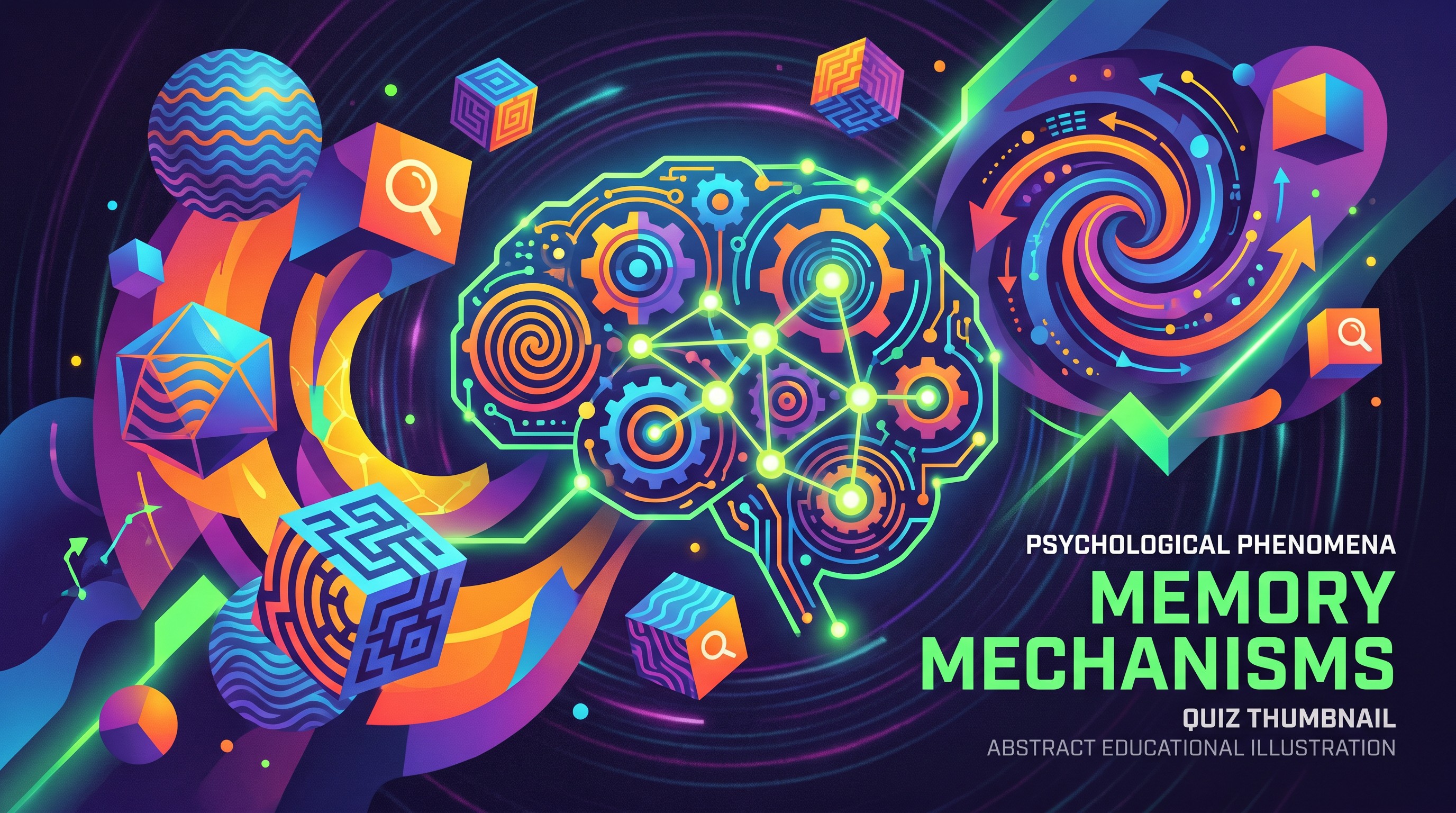
Mind Hacks and Memory
About this quiz
Explore how your brain tricks you.
What this quiz asks
- When you walk from one room into another and suddenly forget what you were looking for, which psychological phenomenon are you experiencing?
- Why does your brain often 'reset' your short-term goals when you cross a physical threshold like a doorway?
- If you are in the kitchen and walk to the living room to grab a book, but forget why you went there, what is the best way to trigger your memory?
- Which scenario most accurately demonstrates a consequence of the Doorway Effect in a daily routine?
- When you smell fresh-baked bread, you suddenly remember your grandmother's kitchen. Which psychological phenomenon is this?
- Why do certain smells, like rain on dry pavement, trigger such intense childhood memories compared to seeing a photo?
- If you are struggling to remember a specific childhood vacation, which action would most likely act as a Sensory Memory Trigger to help you?
- Imagine a student enters a room and forgets why they are there. How could they use Sensory Memory Triggers to remember their original task?
- Look at the image of a person remembering a birthday party. Which concept explains how our brain might accidentally add a detail, like a blue balloon, that was never actually there?
- In this image showing a witness being asked about a car crash, which concept describes how a leading question can change how someone remembers the speed of the vehicles?
- Based on the image of a brain processing conflicting stories, why is it so difficult for us to distinguish between a real event and a False Memory?
- If you are shown a list of related words like 'bed, rest, tired, dream' and later incorrectly remember the word 'sleep' being on the list, which concept explains this error?
- If you read a list of words related to 'ocean' like ship, water, and blue, and then are asked to remember the word 'beach', what psychological trick is occurring when you think you saw the word on the original list?
- A researcher shows you a picture of a healthy apple before asking you to describe a generic fruit. If you describe a red, crunchy object, which mental process has just influenced your description?
- Imagine you are asked to complete the word fragment 'S _ _ P' after seeing a picture of a bar of soap. If you write 'SOAP' instead of 'SOUP', what concept describes how the image guided your brain?
- If a teacher displays a map of a desert before asking students to write a story about a journey, and most students include thirst or heat in their stories, what is the most likely explanation for this shared outcome?
- If you are focusing intensely on counting the number of basketball passes between players in a video, what is the most likely reason you might fail to notice a person in a gorilla suit walking through the scene?
- Looking at this illustration of a busy classroom, why might a student fail to hear the teacher calling their name if they are deeply absorbed in reading a book?
- In this diagram of an eye tracking a path through a maze, what happens to the information outside the direct line of sight?
- Imagine you are trying to find your keys on a cluttered table shown here. Why does your brain 'ignore' the other items like the pens and papers?
- If a witness sees a car crash and is later asked 'How fast was the car going when it smashed into the other vehicle?', they are more likely to report a higher speed than if asked 'How fast was the car going when it hit the other vehicle?'. What is this phenomenon called?
- When researchers show participants a video of a stop sign and then ask a question implying there was a yield sign, participants often later recall seeing a yield sign. Which psychological principle explains this memory distortion?
- A student reads a story about a library and is later asked if they saw a librarian in the story, even though none was mentioned. If the student answers 'yes', what has likely occurred regarding their memory?
- If a police officer asks a witness, 'Did you see the broken headlight?', when there was actually no broken headlight, the witness might later claim they saw one. This is a classic example of which memory-altering concept?
Answer choices and explanations are shown when you take the quiz.
Topics
The Doorway EffectSensory Memory TriggersFalse Memory FormationCognitive PrimingSelective AttentionThe Misinformation Effect
Make your own quiz free
Describe any idea in a sentence and Remee builds it for you — stories, games and
quizzes on whatever you or your class are working on. Free to start, no card needed,
and everything you make gets a link you can share anywhere.
Create a free accountSee it for classrooms
Quizzes on Remee
Remee quizzes come in six formats — including image questions, matching,
drag-and-drop and branching — and can be played live with up to 35 people at once,
which makes them work as easily in a classroom as they do on your own.
 Quiz
Quiz