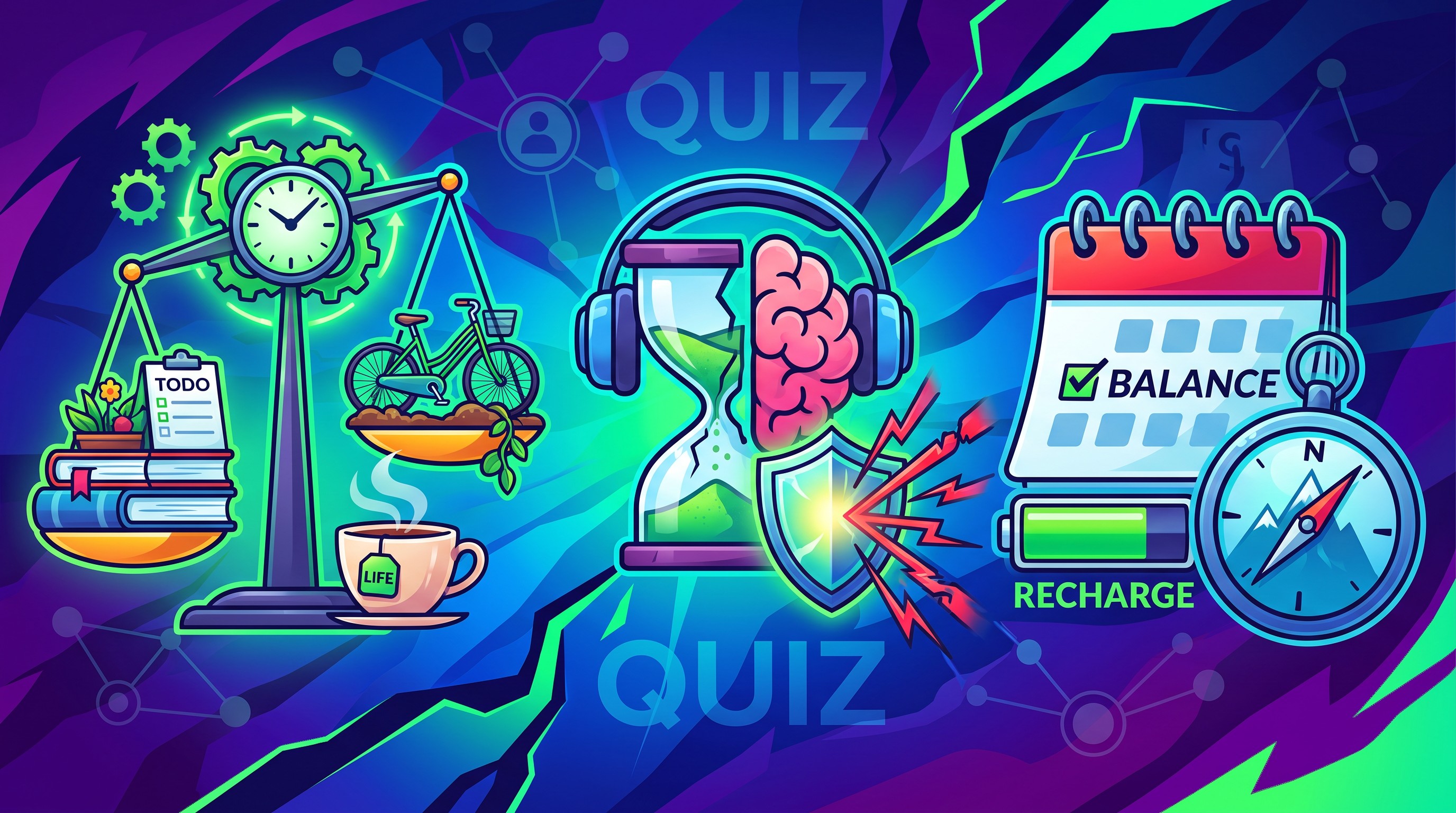
Balance Your Best Life
About this quiz
Master time, rest, and healthy habits.
What this quiz asks
- To manage your study time, you allocate 40% of a 120-minute block to math and 25% to history. How many total minutes are spent on these two subjects?
- You have 3 tasks with priority weights: Task A (weight 3), Task B (weight 5), Task C (weight 2). If you total 100 points of effort, how many points are assigned to Task B?
- An urgent task takes x hours and a secondary task takes 2x hours. Total time is 9 hours. What is the value of x, the time for the urgent task?
- If your productivity rate is 2 tasks per hour, and you have 12 tasks total, how many hours are required to finish? If you only have 4 hours, how many tasks remain?
- To maintain effective scheduling, you allocate 1/4 of your 8-hour day to focused study and 1/8 of the day to reviewing notes. How many total hours are spent on these tasks?
- If your effective scheduling plan requires 3 hours for project work, 1.5 hours for breaks, and 0.5 hours for planning, what is the total time in minutes?
- You have a task that takes 2x hours where x is the number of sub-tasks. If x = 1.5, how many hours should you reserve in your effective scheduling?
- Your effective scheduling allows for 4 hours of work. If you complete 25% of the work in the first hour, how much time remains for the rest?
- To prevent burnout, you need 8 hours of sleep and 2 hours of personal recovery time daily. If a week has 168 total hours, what percentage of your weekly time is dedicated to these essential rest and recovery activities?
- A student recovers energy at a rate defined by E = 5t², where E is energy units and t is time in hours spent resting. How many total energy units are recovered after 4 hours of rest?
- If your stress level S decreases according to the function S = 100 - 15t, where t is hours of restorative activity, how many hours of rest are required to bring your stress level to 25?
- You have a 12-hour block. You spend 1/3 of the time on active recovery and 1/4 of the time on passive rest. How many hours remain for other tasks?
- A student monitors their stress levels on a scale of 1-10. If their morning stress is 3 and it increases by 1.5 units every hour of multitasking, what is their stress level after 4 hours of continuous multitasking?
- To prevent burnout, a person limits their 'high-stress' tasks to a total of 15 hours per week. If they have completed 6.25 hours on Monday and 4.75 hours on Tuesday, how many hours remain for the rest of the week?
- A recovery routine requires at least 0.5 hours of rest for every 2 hours of intense work. If a student works for 7 hours, what is the minimum number of hours of rest required to maintain Stress Recognition?
- To manage stress, a student uses a formula where 'Well-being' = (Total Hours - Stress Hours) / Total Hours. If a student has 24 hours in a day and spends 8 hours on high-stress tasks, what is their well-being index?
- If you dedicate 15% of your 8-hour workday to answering emails, how many minutes are spent on this task per day?
- A student receives 24 notification pings in a 3-hour study block. If the rate of pings is constant, how many pings occur in a 45-minute period?
- Your screen time decreases by 10% each week. If you start at 20 hours, what is your screen time in the 3rd week? (Use the formula A = P(1-r)ⁿ)
- If you need to limit total daily screen time to 120 minutes, and you have already used 45 minutes, what fraction of your remaining limit is 30 minutes?
- To reach a long-term goal of 40 hours of study over 5 weeks, how many hours must be scheduled per week?
- If a long-term project requires 120 total units of effort and you complete 15% of it in the first month, how many units remain?
- To achieve a goal, you increase your weekly study time by a factor of 1.2 every month. If you start at 10 hours, what is your study time in month 3?
- A goal requires a total of 500 hours. You commit to 5 hours/week for 20 weeks, then 8 hours/week for the remainder. How many weeks total to reach 500?
Answer choices and explanations are shown when you take the quiz.
Topics
Prioritization MethodsEffective SchedulingRest and RecoveryStress RecognitionDigital BoundariesLong Term Goal Setting
Make your own quiz free
Describe any idea in a sentence and Remee builds it for you — stories, games and
quizzes on whatever you or your class are working on. Free to start, no card needed,
and everything you make gets a link you can share anywhere.
Create a free accountSee it for classrooms
Quizzes on Remee
Remee quizzes come in six formats — including image questions, matching,
drag-and-drop and branching — and can be played live with up to 35 people at once,
which makes them work as easily in a classroom as they do on your own.
 Quiz
Quiz