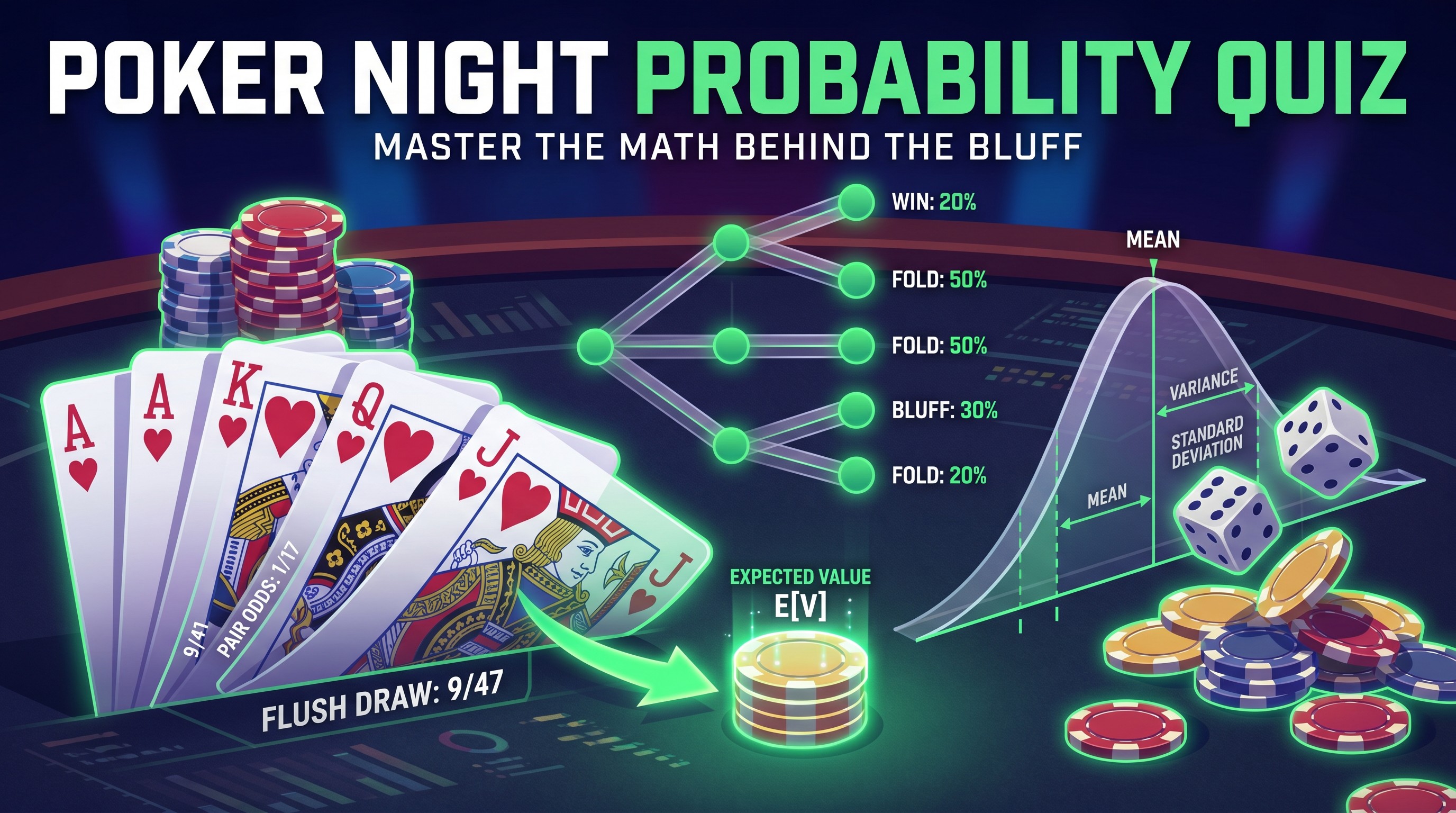
Poker Analytics & Probability
About this quiz
Mastering EV and statistical variance.
What this quiz asks
- In a standard 52-card deck, what is the exact number of possible unique two-card starting hands (combinations) a player can be dealt?
- If you hold a pocket pair (e.g., AA) in Texas Hold'em, how many distinct ways can the remaining 50 cards in the deck form the other two cards of the same rank to complete a set (three-of-a-kind) on the flop?
- Calculate the number of ways to form a flush (all five cards of the same suit) using exactly 5 cards from a 52-card deck, excluding straight flushes.
- In a game of Texas Hold'em, you hold 7-8 suited. How many unique 'flop' combinations (3 cards) contain at least one card of your suit, given that two cards of your suit are already in your hand?
- In a $100 pot, your opponent bets $50. You need to call $50 to see the showdown. What is the required equity you need to justify a call based on pot odds?
- You have a flush draw with 9 outs on the turn. With one card to come, what is your approximate equity percentage?
- If the pot is $400 and your opponent bets $200, what is the minimum equity required to make a profitable call?
- You hold a draw with 25% equity. The pot is $300 and the bet to you is $150. Is this a profitable call?
- You are facing a bet of $50 into a $100 pot. Your equity in the hand is 25%. Calculate the Expected Value (EV) of calling the $50 bet.
- A pot contains $200. An opponent bets $100. You need to call $100. If your win probability is 30%, what is the EV of your call?
- You hold a draw with 9 outs on the turn (44 cards remaining). The pot is $400. Villain bets $200. What is the EV of calling, assuming you fold if you miss on the river?
- You are closing the action. Pot is $500, bet is $200. You need 28.5% equity to break even. If your actual equity is 30%, what is your total profit/loss expectation in dollars?
- A professional poker player with a bankroll of $10,000 plays a game where the standard deviation of their hourly results is $50. After 100 hours of play, what is the standard deviation of their total profit?
- If a player has a 2% risk of ruin for a $20,000 bankroll, what is the approximate probability of ruin if they increase their bankroll to $40,000 while keeping the same betting structure and win rate?
- A player has an hourly win rate of $20 and a standard deviation of $100 per hour. After 400 hours, what is the probability that the player is showing a net loss?
- If a player's bankroll requires 500 big blinds (BB) to survive a 5% risk of ruin, and they decide to play in a game with 2x the variance, what is the new required bankroll (in BB) to maintain the same 5% risk?
- In a heads-up poker scenario, you assign a 60% prior probability to your opponent holding a flush draw. After they bet into a board that contains no flush possibilities, you update your belief using Bayesian Inference. If the likelihood of them betting given they have a flush draw is 0.2, and the likelihood of them betting without a flush draw is 0.8, what is the posterior probability they have the flush draw?
- You are modeling a player's range. Initially, you believe they have a set 10% of the time. They check-raise a dry board. Your model suggests that if they have a set, they check-raise 90% of the time, but if they have air, they check-raise only 5% of the time. What is the updated probability they have a set?
- Consider a situation where you believe an opponent bluffs with frequency P(Bluff) = 0.3. If they bet into you, and you know P(Bet|Bluff) = 0.8 and P(Bet|Value) = 0.4, determine the probability they are bluffing after they bet. If they then bet again on the turn, and you assume P(Bet2|Bluff) = 0.6 and P(Bet2|Value) = 0.9, what is the final posterior probability they are bluffing?
- An opponent's range consists of 40 combos of value hands and 60 combos of bluffs. They bet 100% of their value hands and 50% of their bluffs. If they bet, what is the probability they have a bluff? Furthermore, if they then check-raise 20% of their remaining bluffs and 80% of their value hands, how does the posterior change?
- In a simplified heads-up GTO model, you face a pot of $100 and a bet of $100. To prevent your opponent from exploiting you with a bluff, what is the minimum frequency of calls (defensive range) required to make your opponent indifferent to bluffing?
- Given a pot of $200 and a bet of $100, what is the GTO bluffing frequency (the percentage of hands you should check-raise or bet as bluffs) to remain unexploitable?
- In a GTO scenario, you have a range consisting of 40 value hands and 20 bluffs. If you bet $100 into a $100 pot, what is the required ratio of value to bluffs for your range to be theoretically balanced?
- You are playing a game where you have a 30% equity in a $500 pot. If you employ a GTO strategy that requires a 25% bluff frequency, what is the absolute minimum EV of your bluffing component alone if the bet size is $200?
Answer choices and explanations are shown when you take the quiz.
Topics
Combinatorial Hand AnalysisPot Odds and Equity RatiosExpected Value ModelingVariance and Bankroll DynamicsBayesian Inference in BettingGame Theory Optimal Strategy
Make your own quiz free
Describe any idea in a sentence and Remee builds it for you — stories, games and
quizzes on whatever you or your class are working on. Free to start, no card needed,
and everything you make gets a link you can share anywhere.
Create a free accountSee it for classrooms
Quizzes on Remee
Remee quizzes come in six formats — including image questions, matching,
drag-and-drop and branching — and can be played live with up to 35 people at once,
which makes them work as easily in a classroom as they do on your own.
 Quiz
Quiz