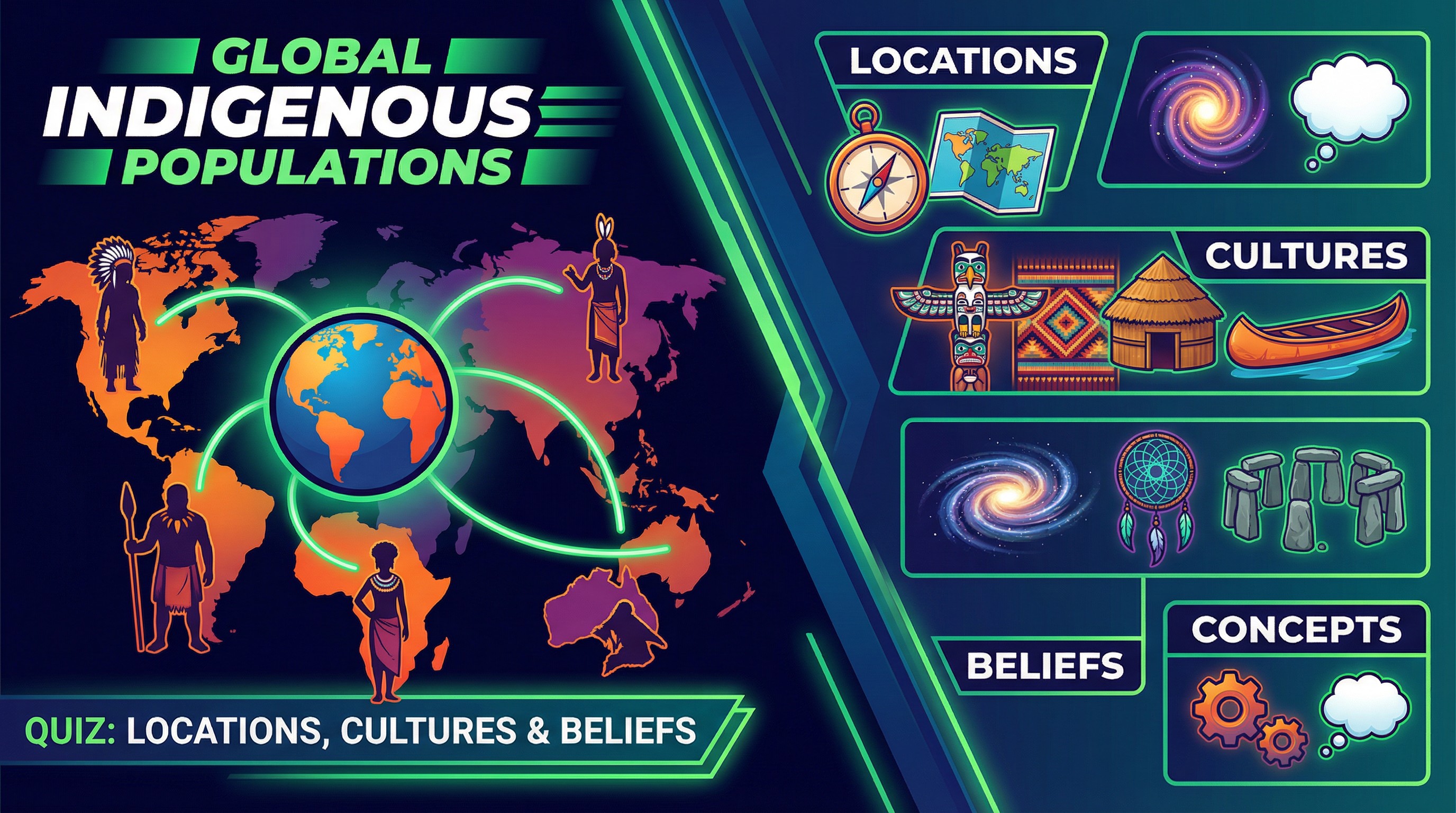
Global Indigenous Peoples
About this quiz
Exploring cultures and lands worldwide
What this quiz asks
- Match these indigenous groups to the major global regions where they have traditionally lived to understand Geographic Distribution.
- Match the indigenous group to their specific geographic environment to explore how Geographic Distribution influences their traditional homelands.
- Match the indigenous peoples to the specific countries or regions where they maintain their primary historical Geographic Distribution.
- Match these indigenous groups to their primary continent or broad region to test your knowledge of global Geographic Distribution.
- Match these indigenous groups to the primary traditional lifestyle they are historically known for.
- Match the traditional tool or structure to the indigenous group that relies on it for their specific Traditional Lifestyle.
- Connect the indigenous group to the specific environmental challenge their Traditional Lifestyle is adapted to overcome.
- Match the indigenous group to the primary food resource that defines their Traditional Lifestyle and regional survival.
- Match these indigenous spiritual concepts with their cultural origins to understand the variety of Spiritual Belief Systems.
- Connect these diverse Spiritual Belief Systems terms with their definitions regarding the relationship between humanity and the natural world.
- Match these specific Spiritual Belief Systems to the regions where they are traditionally practiced by indigenous groups.
- Pair these Spiritual Belief Systems concepts with the primary purpose or function they serve within their respective communities.
- Match these indigenous language groups with the regions where they are traditionally spoken to understand how Oral Traditions and Language are tied to geography.
- Match these storytelling methods with their specific cultural roles to explore how Oral Traditions and Language preserve indigenous knowledge.
- Match these endangered language terms with their cultural significance to understand the challenges of maintaining Oral Traditions and Language in the modern world.
- Match these indigenous linguistic concepts with their definitions to synthesize your knowledge of Oral Traditions and Language.
- Match the following traditional environmental management practices used by indigenous groups with their primary purpose in Environmental Stewardship.
- Match these indigenous groups with the specific environmental challenges they address through their stewardship practices.
- Match the following ecological concepts often found in indigenous worldviews with their modern scientific equivalent.
- Match the specific resource management technique with the ecosystem it is most effectively used to protect.
- Match the modern cultural preservation strategy with its purpose in protecting indigenous heritage.
- Connect the indigenous group to the modern method they use to assert their cultural rights and preservation.
- Pair the term related to Modern Cultural Preservation with its specific impact on community survival.
- Match the challenge to the specific preservation solution used to address it within indigenous communities.
Answer choices and explanations are shown when you take the quiz.
Topics
Geographic DistributionTraditional LifestylesSpiritual Belief SystemsOral Traditions and LanguageEnvironmental StewardshipModern Cultural Preservation
Make your own quiz free
Describe any idea in a sentence and Remee builds it for you — stories, games and
quizzes on whatever you or your class are working on. Free to start, no card needed,
and everything you make gets a link you can share anywhere.
Create a free accountSee it for classrooms
Quizzes on Remee
Remee quizzes come in six formats — including image questions, matching,
drag-and-drop and branching — and can be played live with up to 35 people at once,
which makes them work as easily in a classroom as they do on your own.
 Quiz
Quiz