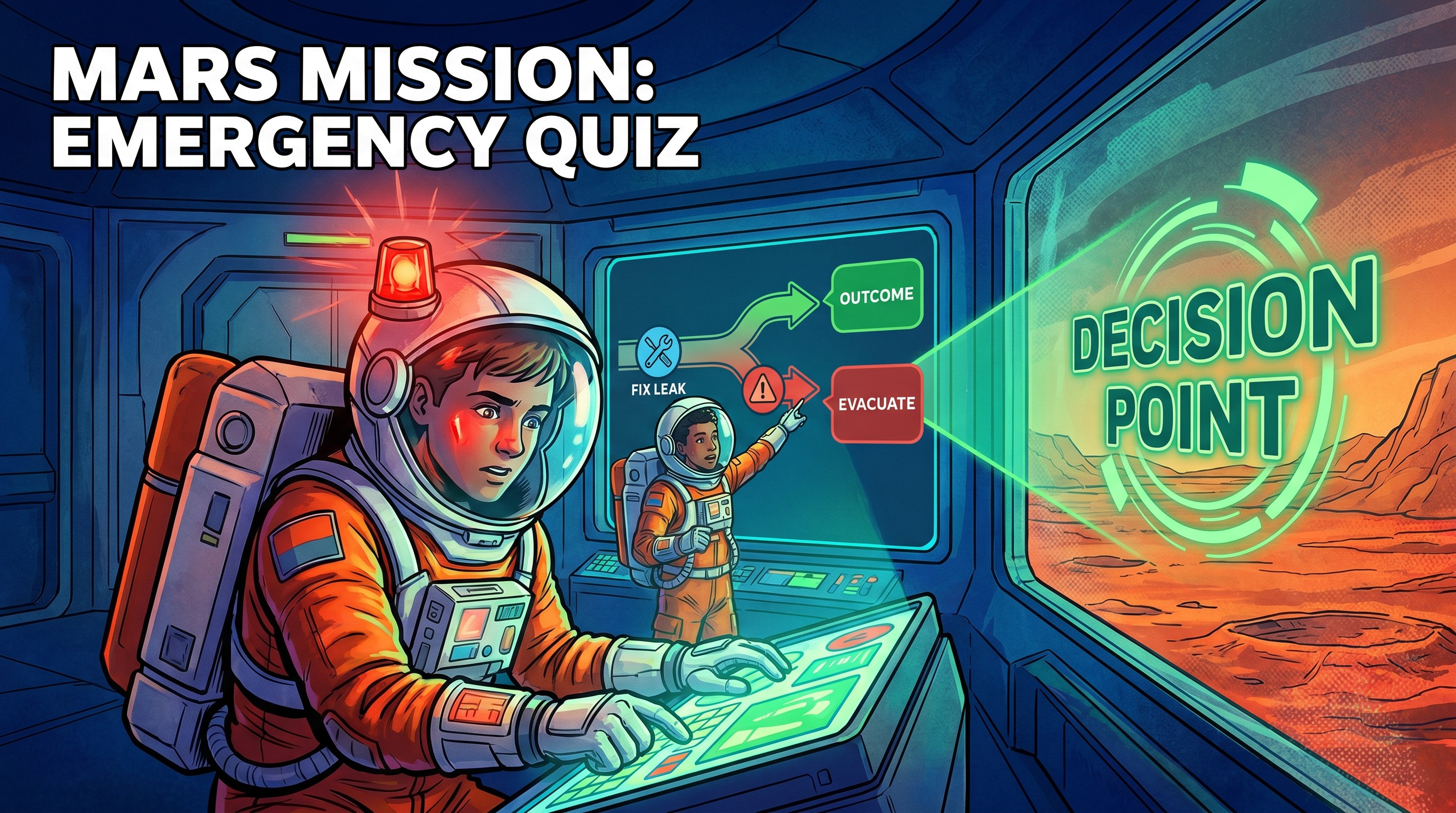
Mars Mission Emergency
About this quiz
Survival skills for teen space explorers.
What this quiz asks
- During your mock mission, a warning light flashes indicating a carbon dioxide scrubber failure. What is your first priority?
- The secondary oxygen tank pressure is dropping rapidly. You have limited time to stabilize the habitat's atmosphere. What do you do?
- A water recycling unit is leaking fluid into the habitat floor. How do you handle this Life Support Systems emergency?
- You are low on both power and oxygen. The Life Support Systems require significant energy to run the scrubbers. What is your strategy?
- During a routine traverse of the Jezero Crater, your rover encounters a sudden, deep patch of loose regolith. How do you maneuver to avoid getting stuck?
- You are scouting a potential landing site for a supply drone. You identify a site with high thermal inertia and another with high albedo. Which do you choose for a stable landing?
- Your team discovers a series of layered sedimentary rock outcrops. To best understand the history of water on Mars, what is your priority for sampling?
- You are analyzing a basaltic rock sample that shows signs of secondary mineral alteration. How do you determine if this alteration was caused by liquid water?
- Your mock Mars habitat loses its primary antenna during a dust storm. You need to send a distress signal to Mission Control. What is the most reliable way to restore communication?
- A solar flare causes a massive spike in background radiation, creating static that drowns out your voice link with Earth. How do you ensure your status report gets through?
- You are receiving a garbled transmission from a rover that is stuck in a crater. The signal is fading in and out. What is your priority action?
- The habitat's main computer crashes, cutting off your primary link to Earth. You have limited power and need to coordinate a rescue. What is your strategy?
- Your mock Mars habitat's water recycler is leaking. You have 20 liters of emergency backup water left. What is your priority action for Resource Management?
- The habitat oxygen scrubber is failing, and power reserves are dropping. You must choose which system to prioritize to maintain life support.
- A dust storm has blocked your solar panels, and food supplies are limited. How do you manage your remaining energy and food?
- You have a limited supply of spare parts to repair either the water recycler or the communication antenna. Which do you fix first?
- After three weeks in the Mars habitat, you notice a fellow crew member feeling dizzy and showing signs of muscle weakness during their daily exercise. What is the most effective way to address these symptoms related to human physiology in space?
- A crew member reports severe headaches and disorientation after a simulated long-duration EVA. Given the constraints of human physiology in space, how should you proceed?
- Your crew is entering their second month on Mars. You notice that everyone is struggling with circadian rhythm disruptions, leading to poor sleep and irritability. What is the most proactive strategy to manage this human physiology in space challenge?
- During a high-intensity research task, a crew member experiences a minor vision change, which is a known risk in human physiology in space. How do you balance mission requirements with their health?
- During a routine check of the Mars habitat, you notice a small structural crack in the outer airlock door. How do you handle this engineering issue?
- The habitat's internal temperature is fluctuating rapidly due to a solar thermal regulation error. What is your priority action?
- Your habitat's radiation shielding tiles are showing signs of degradation after a severe dust storm. How should you address this engineering challenge?
- A power surge has caused the primary habitat life-support hub to shut down, requiring a complex reconfiguration of the power grid. What do you do?
Answer choices and explanations are shown when you take the quiz.
Topics
Life Support SystemsMars Surface GeologyEmergency CommunicationResource ManagementHuman Physiology in SpaceMars Habitat Engineering
Make your own quiz free
Describe any idea in a sentence and Remee builds it for you — stories, games and
quizzes on whatever you or your class are working on. Free to start, no card needed,
and everything you make gets a link you can share anywhere.
Create a free accountSee it for classrooms
Quizzes on Remee
Remee quizzes come in six formats — including image questions, matching,
drag-and-drop and branching — and can be played live with up to 35 people at once,
which makes them work as easily in a classroom as they do on your own.
 Quiz
Quiz