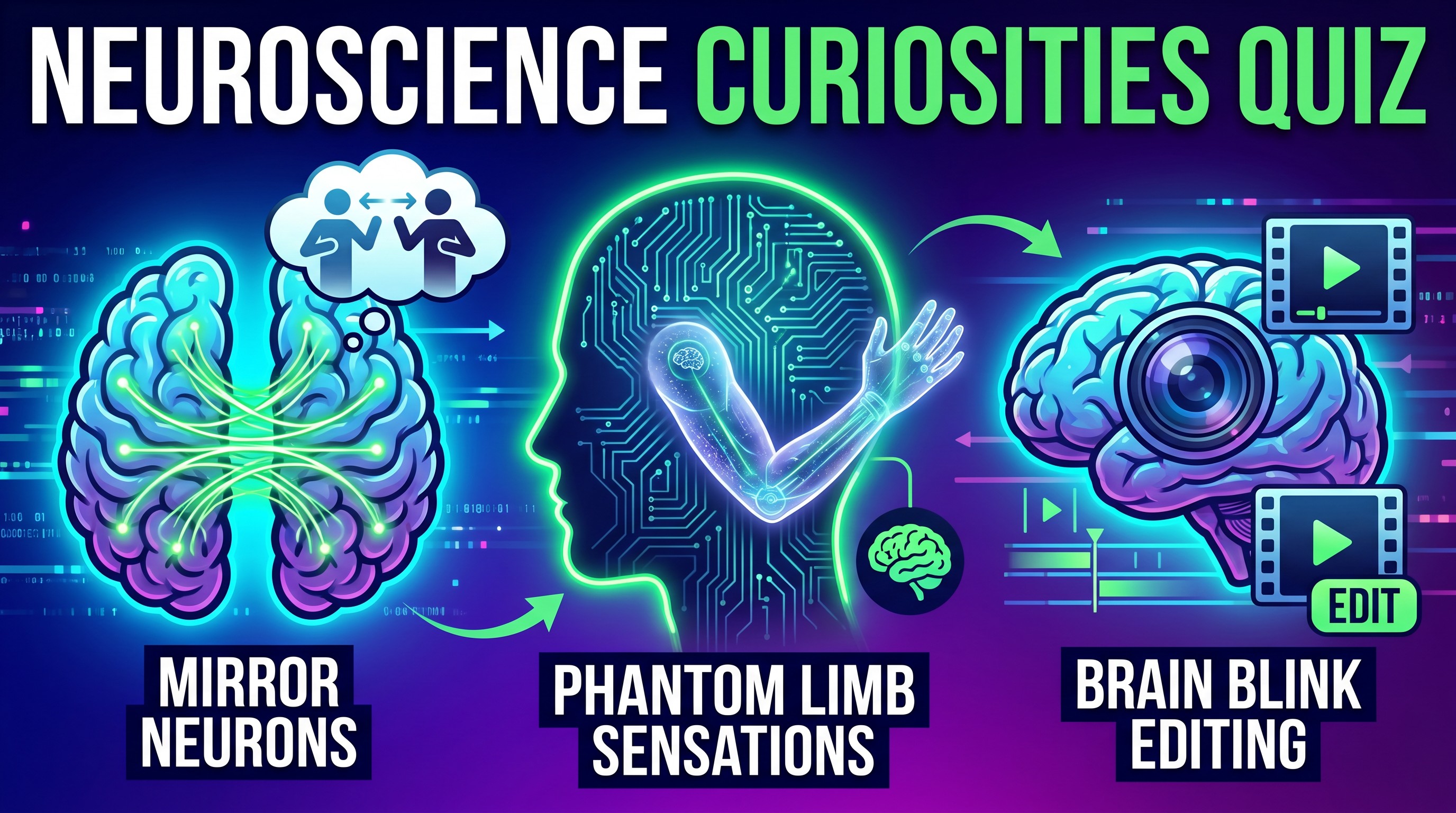
Neuroscience Enigmas
About this quiz
Exploring complex brain phenomena.
What this quiz asks
- Neuroplasticity Fundamentals describe the brain's ability to reorganize itself by forming new neural connections throughout life. Based on the provided illustration of cortical mapping, which process best describes this capacity to adapt after learning a new physical skill?
- When considering Neuroplasticity Fundamentals in the context of sensory input, how does the brain typically respond to the complete loss of sensory feedback from a specific limb?
- Examine the visualization of Hebbian learning, often summarized as 'neurons that fire together, wire together.' How does this principle facilitate the long-term changes associated with Neuroplasticity Fundamentals?
- Integrating the concept of Neuroplasticity Fundamentals with environmental stimuli, analyze the visual representation of synaptic competition. Why is this competitive pruning essential for healthy brain development?
- Observe the illustration of neural pathways firing in the premotor cortex. Which fundamental characteristic of Mirror Neuron Systems is best represented by the simultaneous activation seen in both the observer and the performer?
- Analyze the depicted neural circuit. If a subject observes a precision grasp, which specific functional role of the Mirror Neuron System is highlighted by the firing of these specific premotor neurons?
- Given the provided illustration of the premotor cortex and inferior parietal lobule, how does this circuit contribute to the theory of 'embodied simulation' within the Mirror Neuron System?
- Based on the visual representation of mirror neuron firing thresholds, how might a dysfunction in this system specifically impact an individual's ability to navigate complex social environments?
- When a limb is amputated, the primary somatosensory cortex often continues to receive signals from adjacent regions. Which term describes the process where the brain's sensory map reorganizes to compensate for this input loss?
- A patient experiences a phantom sensation in their missing hand when their face is touched. Based on Penfield's homunculus, why does this specific cross-wiring occur in the context of Phantom Limb Etiology?
- If a mirror box is used to treat phantom limb pain, how does this intervention interact with the underlying Phantom Limb Etiology of the patient?
- Which scenario best illustrates the paradoxical nature of Phantom Limb Etiology regarding the integration of top-down and bottom-up signaling?
- During rapid eye movements, the visual system suppresses information processing to prevent blurred perception. What is the primary function of this Saccadic Masking Mechanism?
- If a person moves their eyes rapidly between two points, why does the brain perceive a seamless transition rather than a dark flicker? Analyze the role of Saccadic Masking Mechanisms.
- Considering the temporal limitations of Saccadic Masking Mechanisms, how does the visual cortex manage the synchronization of incoming data once the eye reaches a new fixation point?
- Evaluate the impact of Saccadic Masking Mechanisms on human performance. Why might this mechanism be considered an evolutionary advantage rather than a sensory deficit?
- When a person closes their eyes and touches their nose with their index finger, they are utilizing proprioceptive integration. Which neural pathway provides the essential feedback loop for this coordinated movement?
- Consider the Rubber Hand Illusion where a participant perceives a fake hand as their own. Which brain region is primarily responsible for the multisensory binding that causes this proprioceptive integration error?
- If a patient suffers from deafferentation, they lose all sensory feedback from their limbs. How does this specifically impact their ability to maintain proprioceptive integration during complex motor tasks?
- During high-speed movement, proprioceptive integration must synchronize with other sensory inputs to prevent perceptual lag. How does the brain compensate when these inputs arrive at different times?
- When you rapidly shift your gaze from one point to another, the brain temporarily suppresses visual processing to prevent the perception of motion blur. What is this phenomenon known as?
- If the brain failed to implement Cognitive Perceptual Editing during saccades, what would a person likely experience while reading or scanning their environment?
- How does the brain differentiate between external movement and self-generated eye movement when applying Cognitive Perceptual Editing?
- When considering the continuity of experience, how does Cognitive Perceptual Editing illustrate the brain's role as an active editor rather than a passive camera?
Answer choices and explanations are shown when you take the quiz.
Topics
Neuroplasticity FundamentalsMirror Neuron SystemsPhantom Limb EtiologySaccadic Masking MechanismsProprioceptive IntegrationCognitive Perceptual Editing
Make your own quiz free
Describe any idea in a sentence and Remee builds it for you — stories, games and
quizzes on whatever you or your class are working on. Free to start, no card needed,
and everything you make gets a link you can share anywhere.
Create a free accountSee it for classrooms
Quizzes on Remee
Remee quizzes come in six formats — including image questions, matching,
drag-and-drop and branching — and can be played live with up to 35 people at once,
which makes them work as easily in a classroom as they do on your own.
 Quiz
Quiz