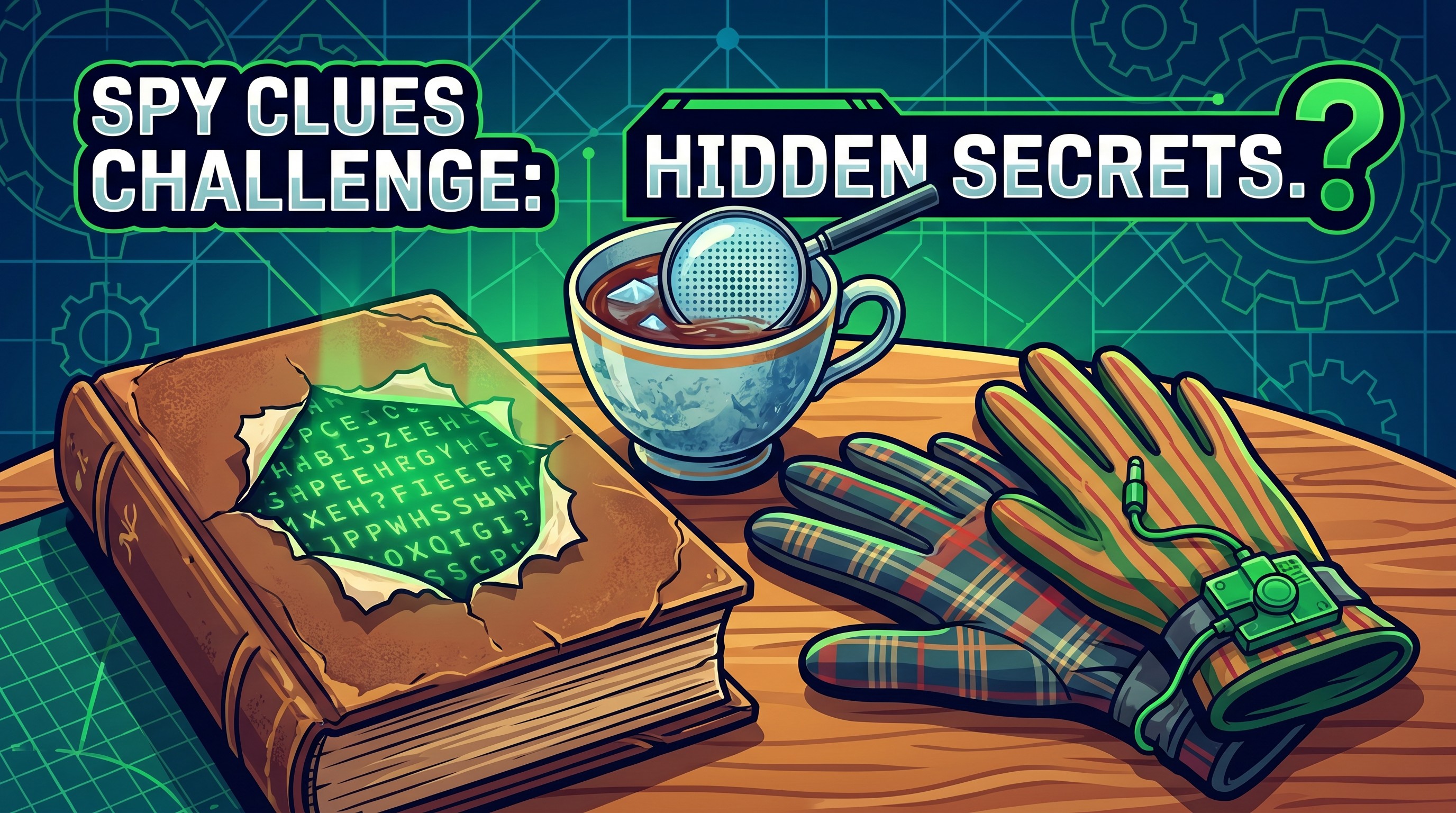
Spy Clues in Everyday Life
About this quiz
Learn to spot secret codes in simple items.
What this quiz asks
- A spy leaves a torn book on a park bench. Which of these pieces would logically be part of a hidden message inside a torn book?
- You find a book with several pages torn out. Which of these patterns could represent a secret code using the missing pages?
- A spy hides a message by tearing pages from a book. Which of these methods allows a receiver to read the message without the original book?
- Select all actions that would help a spy hide a message in a book using the 'Torn Book Pages' concept without being detected.
- A spy leaves a cup of tea on a table. Which of these conditions suggest the tea was used as a Cold Tea Signal?
- A spy finds three cups of tea on a bench. Each has a different temperature. Select the observations that could be part of a Cold Tea Signal code.
- You see a Cold Tea Signal in a cafe. Which actions are correct for a spy to take when reading these signals?
- Which of these scenarios best describe a successful Cold Tea Signal communication?
- A spy leaves two gloves on a park bench. Which of these combinations count as 'Mismatched Glove Codes' where the gloves are truly different types?
- A spy uses Mismatched Glove Codes to signal a meeting time. If a leather glove means 'Morning' and a wool mitten means 'Afternoon', which pairs signal an 'Afternoon' meeting?
- Select the scenarios that would be considered effective Mismatched Glove Codes for a spy trying to remain hidden in a crowd.
- You are decoding a message. If a 'left-hand' glove signifies 'Go North' and a 'right-hand' glove signifies 'Go South', which glove combinations mean 'Go North'?
- A spy leaves three objects on a desk to signal a meeting. Which arrangements show a clear Object Placement Pattern? Select all that apply.
- A spy signals danger by changing the Object Placement Pattern on a windowsill. Which of these changes would be effective signals? Select all that apply.
- You find a desk with a book, a pen, and a cup. Which of these are valid ways to create a coded Object Placement Pattern? Select all that apply.
- Which of these scenarios demonstrates a successful 'Object Placement Pattern' used for a secret message? Select all that apply.
- Which of these materials are best for hiding a secret message so it stays safe and hard to find?
- If you need to leave a message using Hidden Message Materials, which items would allow you to write a code that only a partner knows how to read?
- Which of these scenarios effectively use Hidden Message Materials to pass information during a spy mission?
- Select the materials that could serve as a 'dead drop' container to keep a secret message hidden from plain view.
- A spy leaves a message using Spy Communication Logic. Which of these simple object arrangements could be a pre-arranged signal?
- You find a torn book, a cold cup of tea, and mismatched gloves. Which of these are logical indicators of a message being left behind?
- Select the scenarios that demonstrate effective Spy Communication Logic by using environmental cues.
- Which of these actions follow the principles of Spy Communication Logic for a secure 'dead drop' message?
Answer choices and explanations are shown when you take the quiz.
Topics
Torn Book PagesCold Tea SignalsMismatched Glove CodesObject Placement PatternsHidden Message MaterialsSpy Communication Logic
Make your own quiz free
Describe any idea in a sentence and Remee builds it for you — stories, games and
quizzes on whatever you or your class are working on. Free to start, no card needed,
and everything you make gets a link you can share anywhere.
Create a free accountSee it for classrooms
Quizzes on Remee
Remee quizzes come in six formats — including image questions, matching,
drag-and-drop and branching — and can be played live with up to 35 people at once,
which makes them work as easily in a classroom as they do on your own.
 Quiz
Quiz