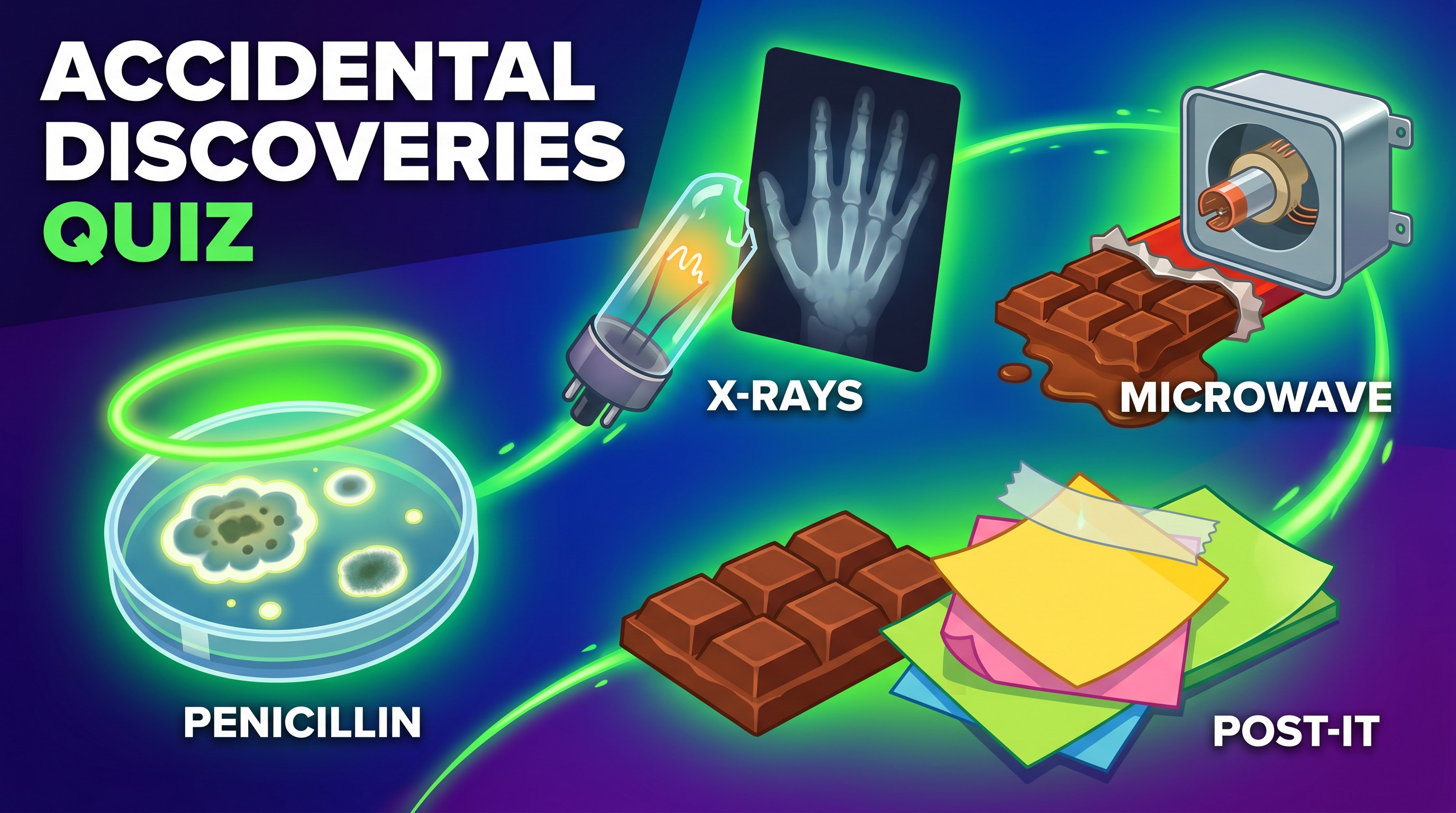
Serendipity in Science
About this quiz
Analyzing unintended scientific breakthroughs
What this quiz asks
- Arrange the following stages of the Empirical Observation Pattern often seen in accidental discoveries, from the initial contact to the formal recognition of a phenomenon.
- Categorize these historical instances of accidental discovery into their respective Empirical Observation Patterns: 'Observational Anomaly' (spontaneous detection) versus 'Systematic Failure' (discovery through broken equipment/procedure).
- Order the following methodological steps of an Empirical Observation Pattern from the most essential for initial identification to the most essential for scientific verification.
- Arrange these components of the Empirical Observation Pattern based on the level of analytical complexity required, from the simplest sensory detection to the most complex synthesis.
- Arrange these accidental discovery events chronologically from the earliest to the most recent occurrence to illustrate Methodological Divergence.
- Categorize these accidental discoveries based on whether the Methodological Divergence occurred during 'Basic Research' or 'Applied Product Development'.
- Order the following stages of Methodological Divergence from the initial observation to the final scientific outcome.
- Classify the following discovery scenarios by the type of Methodological Divergence: 'Intentional Protocol Deviation' vs 'Unplanned Environmental Interference'.
- Cross-disciplinary synthesis often emerges when tools from one field are applied to another. Arrange these accidental discoveries from the field of origin to the field of application.
- Classify these accidental discoveries based on the primary cross-disciplinary synthesis that facilitated their breakthrough.
- Order the following accidental discoveries by the level of technical complexity required for their cross-disciplinary synthesis, from simple observation to complex systemic integration.
- Drag the accidental discovery to the correct 'Synthesis Origin' category, indicating which two fields were merged.
- When researchers encounter unexpected results, they must apply Anomalous Data Interpretation to refine their approach. Arrange these stages of the scientific response to an anomaly from the initial observation to the final hypothesis adjustment.
- Anomalous Data Interpretation often involves categorizing findings based on their potential for future utility. Sort the following accidental discovery types from those requiring immediate theoretical reassessment to those requiring routine procedural adjustment.
- Consider the history of accidental discoveries like Penicillin or Teflon. Arrange these analytical steps of Anomalous Data Interpretation in the order they should be performed when evaluating a surprising, potentially revolutionary data point.
- To master Anomalous Data Interpretation, one must distinguish between different levels of experimental evidence. Order these items from the least reliable form of evidence to the most reliable form when confirming an accidental discovery.
- Technological Spinoff Dynamics often involve repurposing military or industrial research for consumer markets. Arrange these accidental discoveries from the original intended application to the final consumer product.
- In the context of Technological Spinoff Dynamics, some materials are developed for one environment but find utility in another. Sort these materials from their initial high-stress research environment to their common household application.
- Technological Spinoff Dynamics frequently involve medical advancements emerging from non-medical fields. Sequence these steps of an accidental discovery leading to a medical diagnostic tool.
- When analyzing Technological Spinoff Dynamics, it is critical to identify the shift from industrial failure to product success. Arrange these stages of an accidental adhesive discovery from chemical error to market product.
- Arrange the following stages of a scientific paradigm shift, triggered by an accidental discovery, from the initial recognition of the anomaly to the final establishment of a new consensus.
- Categorize the following historical scientific accidents by their primary impact on the scientific paradigm shift they initiated.
- Order the following consequences of a major scientific paradigm shift from the most immediate effect to the most long-term societal integration.
- Arrange these factors by their influence on the 'Paradigm Shift Consequences' process, from the most foundational driver to the final outcome.
Answer choices and explanations are shown when you take the quiz.
Topics
Empirical Observation PatternsMethodological DivergenceCross Disciplinary SynthesisAnomalous Data InterpretationTechnological Spinoff DynamicsParadigm Shift Consequences
Make your own quiz free
Describe any idea in a sentence and Remee builds it for you — stories, games and
quizzes on whatever you or your class are working on. Free to start, no card needed,
and everything you make gets a link you can share anywhere.
Create a free accountSee it for classrooms
Quizzes on Remee
Remee quizzes come in six formats — including image questions, matching,
drag-and-drop and branching — and can be played live with up to 35 people at once,
which makes them work as easily in a classroom as they do on your own.
 Quiz
Quiz