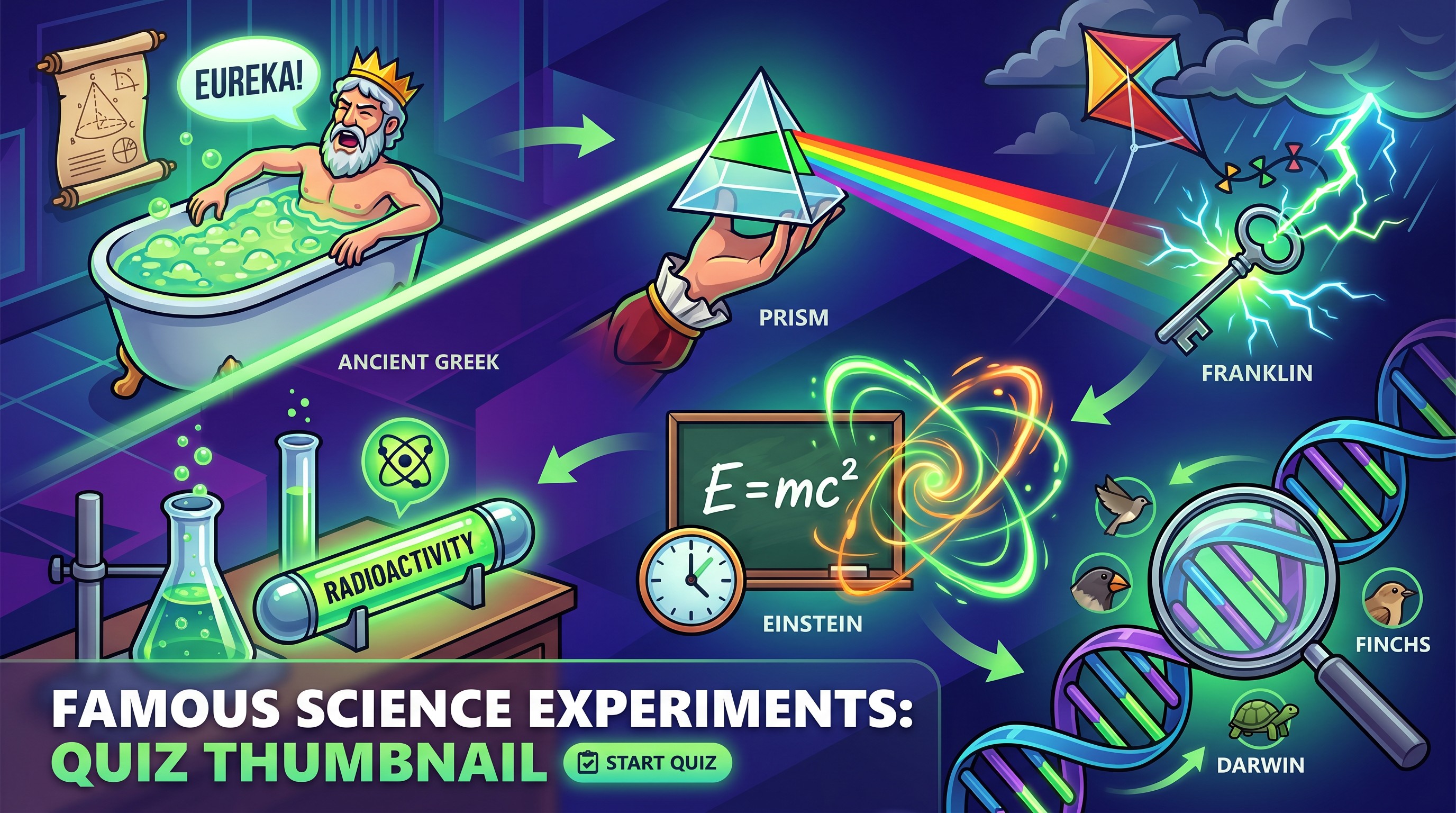
History of Science Discovery
About this quiz
Explore famous experiments that changed us.
What this quiz asks
- Arrange these basic steps of the Scientific Method in the correct order from the first action to the final conclusion.
- Categorize these components of a famous scientific experiment into either 'Independent Variable' (what is changed) or 'Dependent Variable' (what is measured).
- Order these actions from the most important step for ensuring experiment reliability to the least critical for simple demonstrations.
- Arrange these historical research phases of a famous experiment in the order they must occur to build a strong scientific theory.
- Arrange these early physics observations regarding motion from the most basic, stationary state to the most complex, accelerated state of motion.
- Order these famous experimental components from the simplest observation of light to the more complex measurement of light's properties.
- Place these historical physics investigations in order from the simplest study of falling objects to the more advanced study of planetary motion.
- Arrange these steps used in early physics experiments from the initial setup to the final conclusion of the observation.
- Microscopic discoveries changed our view of life. Arrange these items from the smallest scale to the largest scale of biological organization.
- Robert Hooke famously identified cells using early microscopes. Drag these steps into the correct chronological order for observing a cork specimen under a microscope.
- Microscopic discoveries rely on improving technology. Sort these microscope types from the lowest magnification power to the highest magnification power.
- Scientists often categorize observations. Drag these items into the correct category zone: 'Microscopic Life' or 'Non-living Microscopic Structures'.
- Arrange these milestones of the Evolutionary Theory Trials from the simplest observation to the most complex scientific conclusion.
- Sort these steps of the Peppered Moth experiment, which provided evidence for natural selection, from the beginning to the end of the observation period.
- Order the following stages of fossil discovery and analysis used to support evolutionary theory from the initial physical discovery to the final scientific interpretation.
- Arrange these components of the scientific process as they are applied to testing evolutionary hypotheses, from the most specific action to the broadest application.
- Arrange these components of Hans Christian Oersted's discovery from the simplest observation to the scientific conclusion.
- Order the following steps of Michael Faraday's induction experiment from the initial action to the final observation.
- Categorize these historical electromagnetism findings based on whether they describe 'Electricity creating Magnetism' or 'Magnetism creating Electricity'.
- Order the sequence of building a simple electromagnet from the base material to the final functional device.
- Arrange these milestones of Atomic Structure Research from the earliest discovery to the most recent development.
- Categorize these components based on their discovery during key experiments in Atomic Structure Research.
- Order these famous experiments in Atomic Structure Research by the increasing size of the particles they aimed to investigate or detect.
- Place these steps of the scientific process in the correct order as they were applied during the discovery phase of Atomic Structure Research.
Answer choices and explanations are shown when you take the quiz.
Topics
Scientific Method BasicsEarly Physics ObservationsMicroscopic DiscoveriesEvolutionary Theory TrialsElectromagnetism FoundationsAtomic Structure Research
Make your own quiz free
Describe any idea in a sentence and Remee builds it for you — stories, games and
quizzes on whatever you or your class are working on. Free to start, no card needed,
and everything you make gets a link you can share anywhere.
Create a free accountSee it for classrooms
Quizzes on Remee
Remee quizzes come in six formats — including image questions, matching,
drag-and-drop and branching — and can be played live with up to 35 people at once,
which makes them work as easily in a classroom as they do on your own.
 Quiz
Quiz