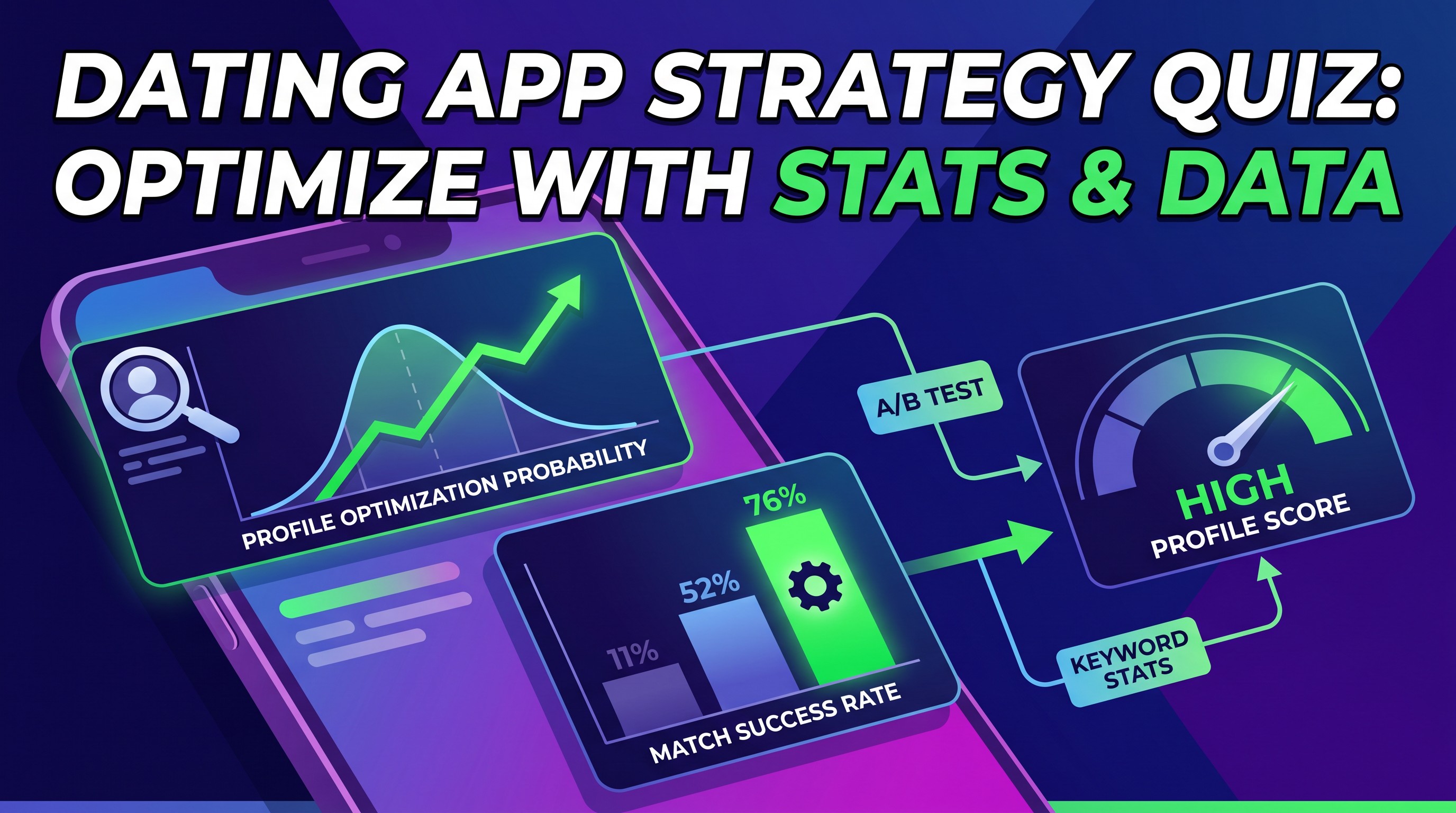
Dating App Algorithmic Optics
About this quiz
Data-driven profile optimization strategies
What this quiz asks
- In an Elo rating system, if User A (Rating 1500) beats User B (Rating 1500) in a match, and the K-factor is 32, what is the new rating of User A? Assume the expected score for an equal rating match is 0.5.
- A profile with an Elo of 1200 defeats a profile with an Elo of 1600. Given a K-factor of 40, what is the rating gain for the underdog? The expected score E for the underdog is 0.14.
- If a dating profile's Elo rating is updated after 5 consecutive matches with a K-factor of 20, where the profile won 3 and lost 2 against opponents of equal rating (E=0.5 each), what is the net change in Elo?
- A profile has a current Elo of 1400. After a set of matches, the rating changes by ΔR = K * (S - E). If the profile wins 10 matches against opponents with an average E of 0.6, and K=20, calculate the new rating.
- In Bayesian Prior Optimization, assume your baseline profile conversion rate is 0.1 (10%). You gather 20 new data points (interactions), of which 5 resulted in a match. Using a Beta distribution as your conjugate prior (α=2, β=18), calculate the updated posterior α' for your profile's success rate.
- You are optimizing your profile photos using Bayesian Prior Optimization. Your prior is Beta(α=4, β=6). After 10 trials, you observe 4 successes. What is the updated β' parameter for your posterior distribution?
- Given a Bayesian Prior Optimization model where your current posterior is Beta(α=10, β=10), what is the Expected Value (E[X]) of your profile's conversion probability?
- You are comparing two profile bio variations using Bayesian Prior Optimization. Bio A has a posterior of Beta(α=15, β=5) and Bio B has Beta(α=20, β=20). Which bio has a higher expected conversion probability?
- In a multivariate A/B test for your dating profile, you compare two photo sets. Set A has a click-through rate (CTR) of 0.04 (4%) and Set B has a CTR of 0.06 (6%). If you test both sets across 1,000 impressions each, what is the expected difference in total matches assuming a 10% conversion rate from click to match?
- You are running a multivariate test on three profile bios (X, Y, Z). The standard error for the conversion rate of Bio X is 0.015. Given a 95% confidence level (z-score = 1.96), what is the margin of error for Bio X?
- In a multivariate test of 4 variables, you want to ensure the probability of a Type I error (α) remains 0.05. If you perform 4 independent comparisons, what is the Bonferroni-corrected significance threshold for each individual test?
- If your Multivariate A/B testing setup shows that variant A has a conversion rate of 10% with 200 samples and variant B has a conversion rate of 15% with 200 samples, what is the pooled proportion used to calculate the test statistic?
- In a simplified Stochastic Matching Model, the probability P of a match occurring is defined by the product of user attraction scores α and β. If α = 0.2 and β = 0.4, calculate the probability P of a successful match.
- A platform uses a Stochastic Matching Model where the arrival rate of compatible profiles follows a Poisson distribution with λ = 5 profiles/hour. What is the probability of receiving exactly 3 profiles in one hour?
- In a Stochastic Matching Model, the expected time between matches T follows an exponential distribution with rate μ = 0.5 matches/hour. Calculate the probability that a match occurs within the first 2 hours.
- A matching system uses a queueing model where the system capacity is C = 10 and the utilization factor ρ = 0.8. Under steady-state conditions in a Stochastic Matching Model, what is the probability that the system is empty (P₀)?
- If your profile has a baseline CTR of 0.05 and you implement a new tag that increases the conversion probability by 20% relative to the baseline, what is the new CTR?
- You are testing two profile photos. Photo A had 20 clicks out of 400 views. Photo B had 30 clicks out of 500 views. Which photo has the higher CTR and what is the difference in percentage points?
- If a profile feature has a binary indicator variable x, where x=1 represents 'includes hobby' and x=0 represents 'no hobby', and the log-odds of a click is given by ln(p/(1-p)) = 0.5 + 0.3x, calculate the probability p when x=1.
- In a feature space with two predictors, user-age (x1) and bio-length (x2), if the contribution to CTR is defined by 0.02x1 + 0.001x2, calculate the total contribution for a 30-year-old user with a 200-character bio.
- In Predictive Conversion Modeling, if your profile receives 200 impressions daily with a baseline click-through rate (CTR) of 0.05, how many expected daily profile visits (conversions) should you model?
- Your profile conversion model predicts a daily visit rate of λ = 4 visits/day. Assuming a Poisson distribution for arrivals, what is the probability of receiving exactly 0 visits in a day?
- If your profile conversion rate increases from 2% to 3% due to optimization, and you receive 1000 impressions, what is the relative percentage increase in expected conversions?
- Using Predictive Conversion Modeling, if the probability of a match is p=0.1, what is the variance of matches in 100 profile views?
Answer choices and explanations are shown when you take the quiz.
Topics
Elo Rating SystemsBayesian Prior OptimizationMultivariate A/B TestingStochastic Matching ModelsFeature Engineering for CTRPredictive Conversion Modeling
Make your own quiz free
Describe any idea in a sentence and Remee builds it for you — stories, games and
quizzes on whatever you or your class are working on. Free to start, no card needed,
and everything you make gets a link you can share anywhere.
Create a free accountSee it for classrooms
Quizzes on Remee
Remee quizzes come in six formats — including image questions, matching,
drag-and-drop and branching — and can be played live with up to 35 people at once,
which makes them work as easily in a classroom as they do on your own.
 Quiz
Quiz