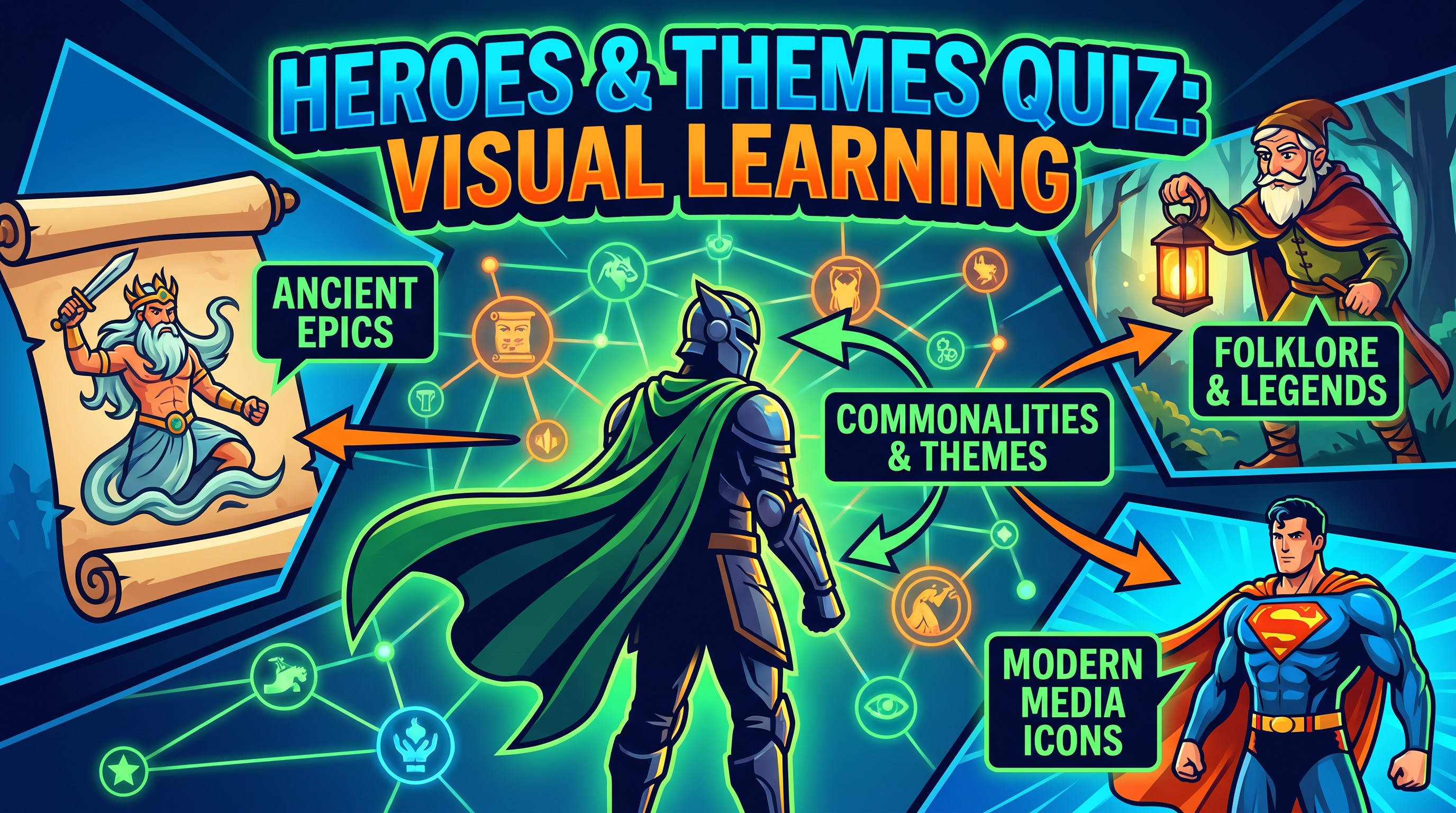
Archetypes and Cultural Heroes
About this quiz
Cross-cultural analysis of heroic tropes.
What this quiz asks
- In the context of Monomythic Structuralism, which stage represents the hero's initial departure from the familiar world to enter a threshold of unknown challenges?
- Analyze the visual representation of the hero's journey cycle. Which element of Monomythic Structuralism is best characterized by a period of profound transformation or death and rebirth?
- Considering the universal structural patterns identified by Joseph Campbell, which phase involves the hero securing the ultimate goal or wisdom, often requiring a struggle against a shadow force?
- How does the 'Apotheosis' stage within Monomythic Structuralism function as a structural pivot point for the hero's narrative arc, as depicted in this symbolic progression?
- In many ancient epic traditions, the protagonist's journey is governed by 'Cultural Ethical Mandates' that define heroism through specific social duties. Which element typically represents the fundamental tension between individual desire and these communal obligations in such narratives?
- When analyzing 'Cultural Ethical Mandates' across diverse mythologies, how does the concept of 'Dharma' in Hindu epics fundamentally differ from the 'Heroic Code' seen in the Iliad, specifically regarding the protagonist's ultimate objective?
- Consider the 'Cultural Ethical Mandates' that dictate a hero's interactions with the divine. In many cultures, why is the 'pious hero' archetype often required to suffer, rather than succeed through purely pragmatic means?
- How do 'Cultural Ethical Mandates' evolve when a society transitions from a warrior-based heroism to a governance-based heroism? Observe the transition shown in the visual to determine the shift in the protagonist's ethical burden.
- Consider the Greek concept of 'hubris' leading to a fall. How does this contrast with the 'divine favor' often bestowed upon heroes in Mesopotamian epics like the Epic of Gilgamesh?
- When analyzing the 'Tragic Flaw vs. Divine Favor' dynamic, why does the hero Achilles represent a deviation from standard heroic archetypes when he rejects divine counsel?
- In many West African epic traditions, such as the Sundiata Keita, how is the 'divine favor' of the hero portrayed differently than the 'tragic flaw' seen in Western classical tragedies?
- How does the 'Tragic Flaw vs. Divine Favor' framework synthesize the hero's internal psychological state with their external relationship to the supernatural?
- Observe the symbolic depiction of a warrior protecting a harvest field. How does this image illustrate the Societal Archetype Reflection of a culture that values communal stability over individual glory?
- Examine the balance of the architectural structures in this image. Which interpretation best aligns with the Societal Archetype Reflection of a civilization that promotes the hero as a bridge between the physical and spiritual realms?
- Analyze the juxtaposition of the broken chain and the heavy anvil in this visual. How does this reflect the Societal Archetype Reflection regarding a culture that views the hero as a liberator from structural oppression?
- Review the depiction of the central lighthouse beam casting light across a chaotic sea. How does this image synthesize the Societal Archetype Reflection of a hero acting as a beacon of cultural identity amidst external influence?
- In the context of Anti-Heroic Deconstruction, which visual representation best illustrates the subversion of the traditional hero's moral certainty?
- Analyze the shift in power dynamics depicted in the image. How does this reflect the Anti-Heroic Deconstruction of the 'Chosen One' archetype?
- Considering the concept of Anti-Heroic Deconstruction, which narrative element is most likely to replace the classic 'Hero's Reward' as shown in this visual?
- The image displays a fractured mirror reflecting multiple, conflicting versions of a single figure. How does this imagery synthesize the core tenets of Anti-Heroic Deconstruction?
- When comparing the journey of Odysseus in Greek mythology with the journey of Sun Wukong in Chinese literature, which element best characterizes their commonality in the context of Comparative Mythic Synthesis?
- Analyze the role of the 'Supernatural Aid' in both the Epic of Gilgamesh and the Icelandic Sagas. How does Comparative Mythic Synthesis explain the function of these divine interventions?
- Consider the 'Return' phase of the hero's journey in diverse cultures. How does Comparative Mythic Synthesis interpret the hero's reintegration into their society after a quest?
- When synthesizing the archetypal 'Shadow' figure across different mythologies, what does Comparative Mythic Synthesis suggest about the relationship between the hero and their antagonist?
Answer choices and explanations are shown when you take the quiz.
Topics
Monomythic StructuralismCultural Ethical MandatesTragic Flaw Vs. Divine FavorSocietal Archetype ReflectionAnti Heroic DeconstructionComparative Mythic Synthesis
Make your own quiz free
Describe any idea in a sentence and Remee builds it for you — stories, games and
quizzes on whatever you or your class are working on. Free to start, no card needed,
and everything you make gets a link you can share anywhere.
Create a free accountSee it for classrooms
Quizzes on Remee
Remee quizzes come in six formats — including image questions, matching,
drag-and-drop and branching — and can be played live with up to 35 people at once,
which makes them work as easily in a classroom as they do on your own.
 Quiz
Quiz