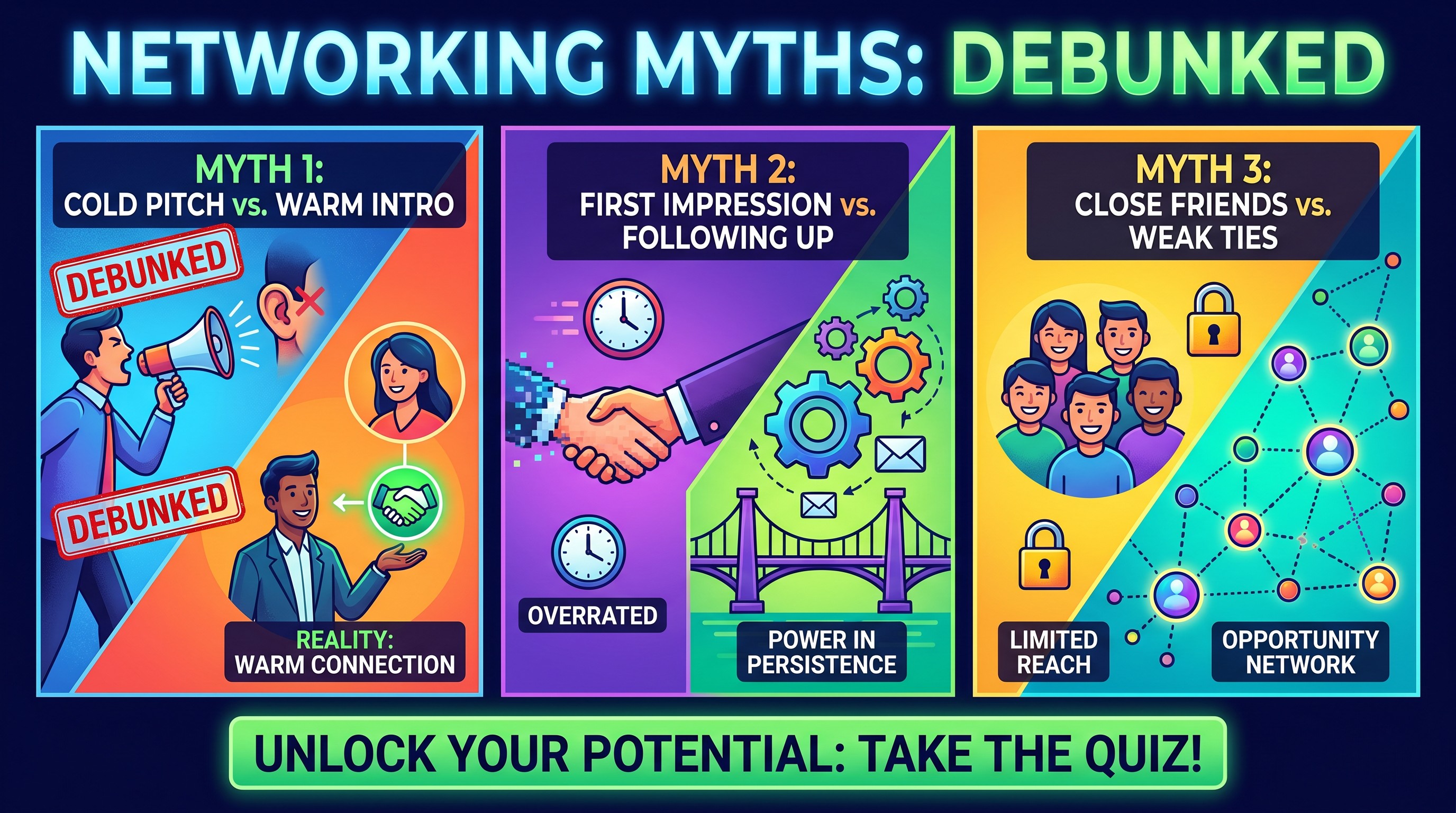
Strategic Networking Decoded
About this quiz
Debunking myths in professional connection.
What this quiz asks
- In the context of Warm Introduction Dynamics, which visual representation best illustrates the principle of 'social proof amplification' when a mutual contact facilitates a connection?
- When analyzing the efficacy of Warm Introduction Dynamics, which diagram demonstrates the 'filtering effect' that occurs before a request reaches the decision-maker?
- Considering the structural advantage of Warm Introduction Dynamics, which image represents the reduction of 'transactional friction' compared to cold outreach?
- Evaluate the network topology shown. Which image correctly models the 'trust transfer' mechanism inherent in Warm Introduction Dynamics?
- When evaluating Cold Outreach Efficacy, which visual pattern best represents the conversion funnel of a high-value cold email campaign compared to a generic broadcast?
- In the context of Cold Outreach Efficacy, how does the 'signal-to-noise' ratio change as you move from automated mass-blasting to data-driven, personalized outreach?
- Analyze the visual representation of 'Cold Outreach Efficacy' thresholds. At what point does increased volume negatively impact the efficacy of a cold outreach strategy?
- Given the visual model of a 'Value-Exchange Loop,' which element is critical for sustaining Cold Outreach Efficacy in a professional networking ecosystem?
- In Impression Management Science, which concept describes the tendency for an individual to adjust their self-presentation based on the perceived expectations of a specific audience?
- When evaluating the 'Primacy Effect' in Impression Management Science, what does the visual data suggest regarding the influence of a first interaction?
- In the context of Impression Management Science, how does the 'Spotlight Effect' distort an individual's perception of their own networking performance?
- When applying Impression Management Science to professional networking, how does the integration of 'Authenticity' and 'Strategic Self-Presentation' affect long-term credibility?
- In the context of Follow-up Cadence Analytics, what is the optimal interpretation of the 'decay curve' regarding the probability of a professional connection responding to a cold outreach effort over a 14-day period?
- When analyzing Follow-up Cadence Analytics, which frequency model best mitigates the 'nuisance effect' while maximizing the 'top-of-mind' recall for a new business contact?
- How does the 'Saturation Point' in Follow-up Cadence Analytics influence the decision to stop pursuing a cold contact?
- In Follow-up Cadence Analytics, how should one adjust their strategy when transitioning from a 'cold' initial pitch to a 'warm' follow-up phase after the first interaction?
- According to Granovetter's Weak Tie Network Theory, why are 'weak ties' typically more effective for gathering novel job market information than 'close-knit' clusters?
- In the context of career mobility, how does the 'strength of weak ties' contrast with the limitations of 'close-knit' friendship circles?
- Why is it considered a networking fallacy to rely exclusively on 'close-knit' clusters for professional growth according to network analysis?
- When applying Weak Tie Network Theory to career strategy, which action best optimizes your network structure for long-term professional expansion?
- In the context of network topology, why do close-knit clusters often suffer from 'information redundancy' compared to a more heterogeneous network structure?
- When analyzing the 'homophily' effect in professional networks, what is the primary risk associated with maintaining exclusively high-density, close-knit clusters?
- Which phenomenon, illustrated by the 'structural hole' theory, suggests that occupying a position between two distinct, non-overlapping clusters provides a competitive advantage?
- How does the 'strength of weak ties' principle fundamentally challenge the utility of maintaining only a close-knit cluster of professional associates?
Answer choices and explanations are shown when you take the quiz.
Topics
Warm Introduction DynamicsCold Outreach EfficacyImpression Management ScienceFollow up Cadence AnalyticsWeak Tie Network TheoryClose Knit Cluster Limitations
Make your own quiz free
Describe any idea in a sentence and Remee builds it for you — stories, games and
quizzes on whatever you or your class are working on. Free to start, no card needed,
and everything you make gets a link you can share anywhere.
Create a free accountSee it for classrooms
Quizzes on Remee
Remee quizzes come in six formats — including image questions, matching,
drag-and-drop and branching — and can be played live with up to 35 people at once,
which makes them work as easily in a classroom as they do on your own.
 Quiz
Quiz