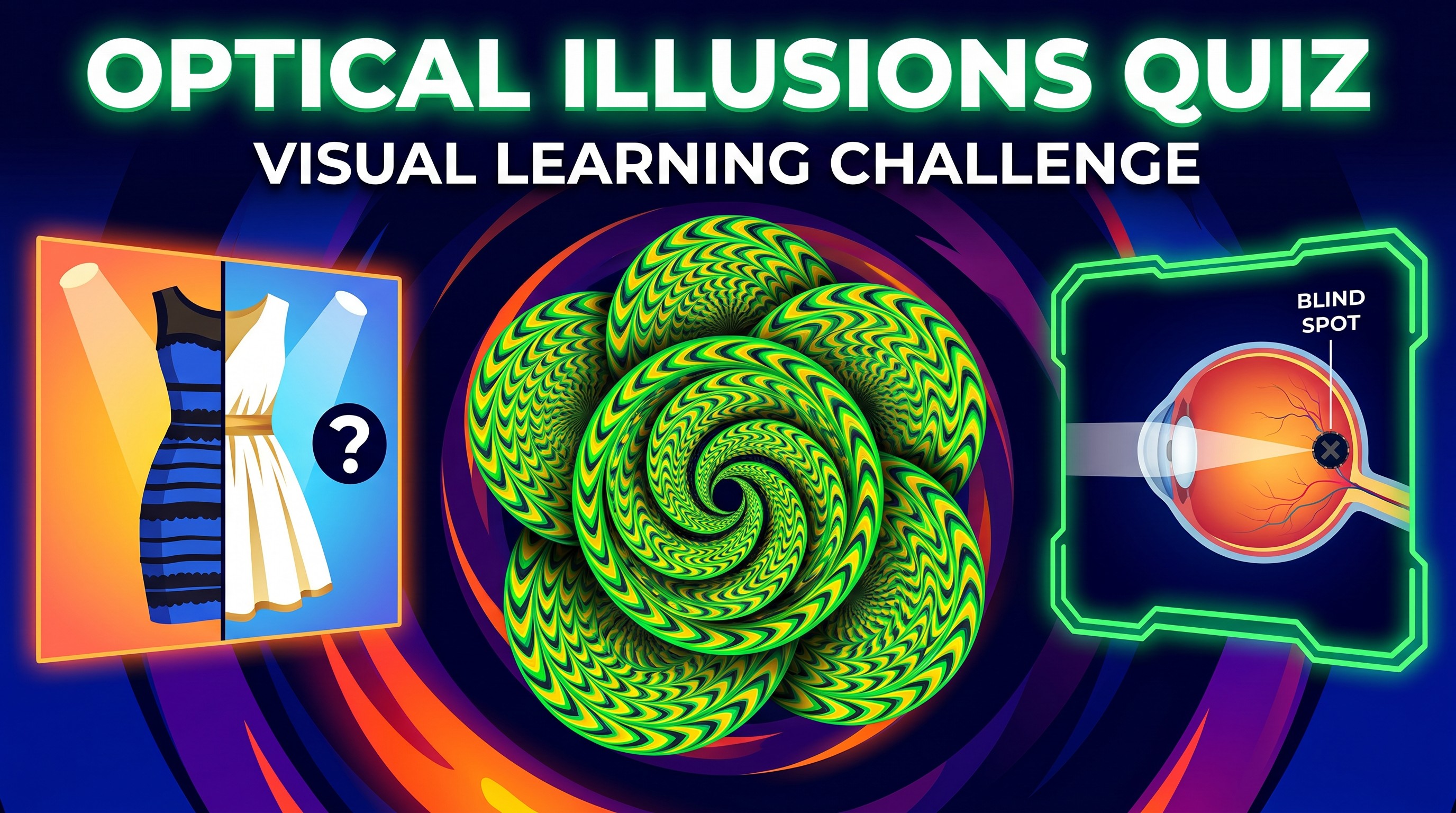
Visual Perception Mechanics
About this quiz
Analyzing cognitive illusions and sight.
What this quiz asks
- The human retina contains a specific region where the optic nerve exits the eye, resulting in a total absence of photoreceptors. Based on this, which statement best describes why we perceive a 'blind spot' in our visual field?
- When viewing the 'Rotating Snakes' illusion, peripheral motion perception is triggered by the specific arrangement of color patterns. How does the distribution of rods and cones contribute to this effect?
- Consider the difference between foveal and peripheral vision. If an image is projected solely onto the fovea, which of the following is true regarding the resulting visual perception?
- How would the perception of a low-light optical illusion change if the stimulus were shifted from the fovea to the peripheral retina, and why?
- When observing the Rotating Snakes illusion, the brain interprets micro-saccades and luminance gradients as motion. Which neural pathway is primarily responsible for processing these rapid changes in visual contrast?
- In the context of the dress illusion, the brain must make an assumption about the ambient lighting conditions before processing color. How do Neural Signal Processing Pathways facilitate this color constancy?
- The physiological blind spot exists where the optic nerve exits the retina, lacking photoreceptors. How does the brain's Neural Signal Processing Pathways handle the resulting 'gap' in the visual field?
- If an optical illusion creates conflicting inputs for the visual cortex, how do Neural Signal Processing Pathways prioritize the incoming information to resolve the discrepancy?
- When viewing the rotating snakes illusion, why does the peripheral motion perception system create an illusory sense of movement despite the image being static?
- How does the phenomenon of peripheral motion perception explain the persistence of illusory movement when a viewer shifts their gaze away from the center of a complex pattern?
- Analyze the role of microsaccades in the context of peripheral motion perception; how do these involuntary eye movements contribute to the rotating snakes illusion?
- Synthesize the concepts of luminance contrast and peripheral motion perception to explain why the rotating snakes illusion fails to trigger movement when viewed directly by the fovea.
- In the context of Chromatic Constancy Errors, why does the perception of 'the dress' fluctuate between blue-black and white-gold when observed under different illumination assumptions?
- How does the phenomenon of Chromatic Constancy Errors influence the way an observer interprets the shadow cast across a surface in an optical illusion?
- Analyze the impact of 'Chromatic Constancy Errors' on color perception when an observer is presented with an object illuminated by a monochromatic light source.
- Evaluate how the interaction between Chromatic Constancy Errors and peripheral visual processing affects the stability of color perception in complex optical illusions.
- When observing a classic binocular rivalry stimulus, such as a red vertical grating presented to one eye and a green horizontal grating to the other, what is the primary perceptual outcome experienced by the viewer?
- How does the phenomenon of binocular rivalry challenge the traditional 'fusion' model of human stereoscopic vision?
- During experiments involving Binocular Rivalry Phenomena, what happens to the neural activity in the primary visual cortex when a subject reports a switch in perception from one image to the other?
- If an individual is presented with an image of a house in one eye and a face in the other, how might the Binocular Rivalry Phenomena interact with high-level cognitive biases, and what is the expected outcome?
- In the context of Gestalt Perceptual Organization, which principle explains our tendency to perceive the 'Rotating Snakes' illusion as having continuous motion despite the static nature of the image?
- When observing a complex visual stimulus like 'The Dress', how does the Gestalt principle of Pragnanz (the law of simplicity) influence our perception of its color?
- How does the principle of 'closure' in Gestalt Perceptual Organization help explain why the blind spot in our vision is rarely noticed during daily activities?
- Considering Gestalt Perceptual Organization, how does the integration of 'figure-ground' perception and 'proximity' contribute to the illusion of depth in complex visual displays?
Answer choices and explanations are shown when you take the quiz.
Topics
Retinal Photoreceptor DistributionNeural Signal Processing PathwaysPeripheral Motion PerceptionChromatic Constancy ErrorsBinocular Rivalry PhenomenaGestalt Perceptual Organization
Make your own quiz free
Describe any idea in a sentence and Remee builds it for you — stories, games and
quizzes on whatever you or your class are working on. Free to start, no card needed,
and everything you make gets a link you can share anywhere.
Create a free accountSee it for classrooms
Quizzes on Remee
Remee quizzes come in six formats — including image questions, matching,
drag-and-drop and branching — and can be played live with up to 35 people at once,
which makes them work as easily in a classroom as they do on your own.
 Quiz
Quiz