Tech History Surprises
About this quiz
Uncovering the odd roots of modern tech.
What this quiz asks
- Which famous mathematician is considered the world's first computer programmer for her work on the Analytical Engine?
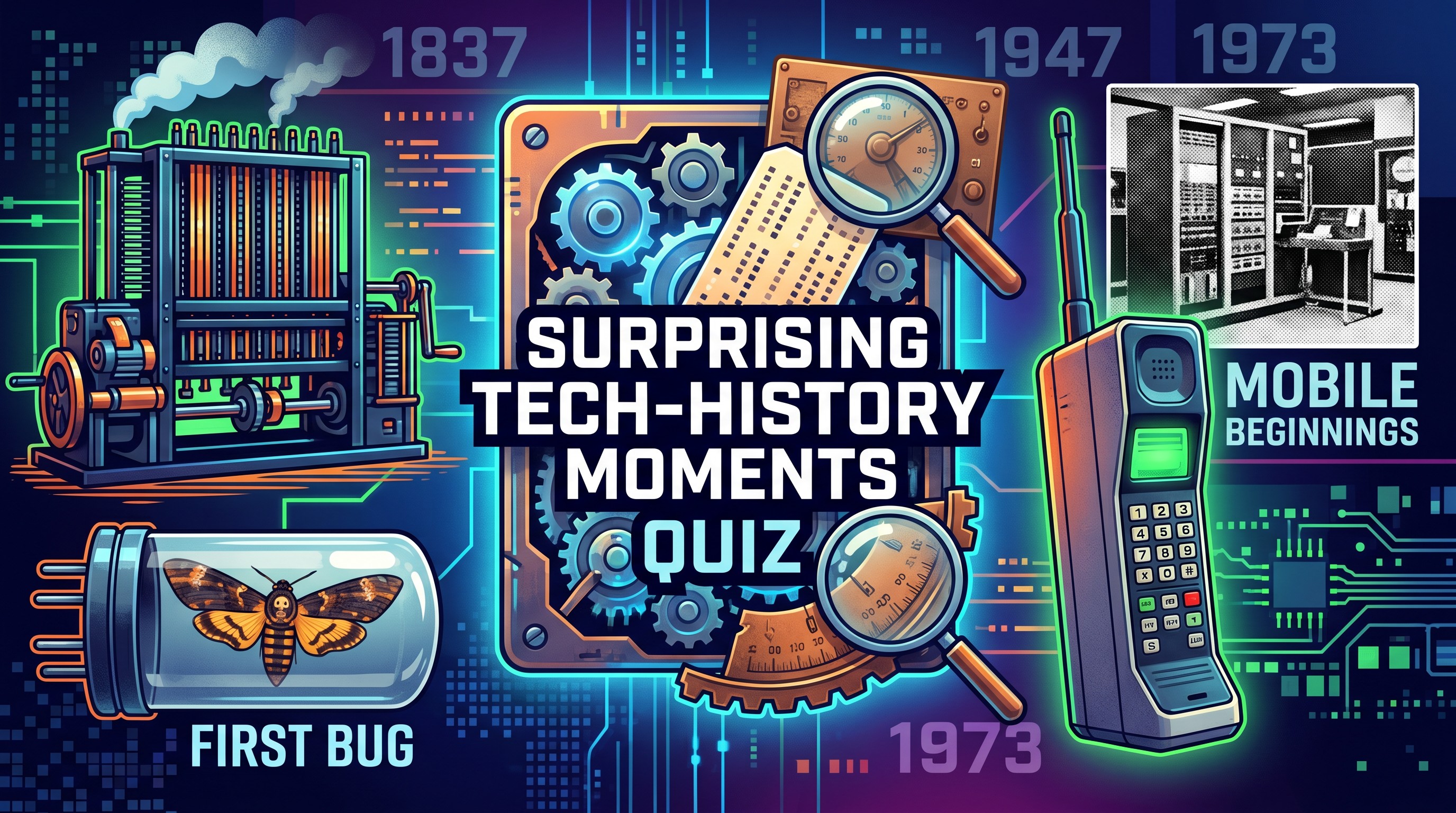
- Look at the machine in the image. Which pioneer designed this Difference Engine to perform complex mathematical calculations automatically?
- This device represents the logic used by which pioneer to crack the Enigma code, a major milestone in Early Computing Pioneers history?
- The image shows a moth found inside a computer. Which pioneer popularized the term 'debugging' after discovering this issue?
- A chemist working on artificial sweeteners accidentally licked his finger and discovered a new substance. Which product was created this way?
- While experimenting with radar technology, an engineer noticed a candy bar in his pocket had melted. What device did this lead to?
- A scientist trying to create a super-strong adhesive ended up with a weak glue that left no residue. What was this accidental product?
- When Roy Plunkett attempted to create a new refrigerant gas, he opened his canister and found a white, slippery solid instead. What material was this?
- Before the internet, the telegraph revolutionized long-distance messaging. Looking at this device, which component was essential for tapping out the rhythmic pulses of Morse code?
- Alexander Graham Bell's early telephone used a liquid transmitter to carry sound. Based on this historical setup, what did the liquid actually help convert?
- Early radio transmitters used spark gaps to send messages. If you look at the bright arc in this image, what physical phenomenon is creating the radio signal?
- Looking at this image of an early fiber optic strand, how does it physically enable the high-speed communication revolution we rely on today?
- In the 1990s, a portable gaming device was released that used red-and-black graphics to simulate 3D depth. Why did this Failed Tech Experiment fail to capture the market?
- The Sinclair C5 was a small, battery-powered electric vehicle released in the 1980s. Based on its design, what was the primary reason it became a Failed Tech Experiment?
- Before modern tablets, a company released a device called the Newton. Why did this early attempt at a handheld computer end up as a Failed Tech Experiment?
- Looking at the design of the Betamax tape, how did its physical size influence its status as a Failed Tech Experiment compared to the VHS format?
- In the early days of computing, which device used spinning magnetic platters to store data, representing a major jump from punch cards?
- What technology, often found in early home computers, allowed users to save programs by converting digital bits into audible sound frequencies?
- Which storage medium, characterized by a flexible plastic casing, became the standard for data portability before high-capacity flash drives existed?
- What modern storage technology stores data as electrical charges in floating-gate transistors, eliminating the need for moving parts?
- Which common hardware component originally used a series of punched cards, similar to those seen in early textile looms, to store data?
- The vacuum tube, a precursor to the modern transistor, relied on which physical phenomenon to function within early electronic hardware?
- What surprising material was used as the base for the first 'magnetic tapes' used in early data storage devices?
- If you look at the structure of an early integrated circuit, which geometric pattern is commonly used to maximize the density of the etched pathways?
Answer choices and explanations are shown when you take the quiz.
Topics
Early Computing PioneersAccidental InventionsCommunication RevolutionsFailed Tech ExperimentsEvolution of Data StorageHidden Origins of Hardware
Make your own quiz free
Describe any idea in a sentence and Remee builds it for you — stories, games and
quizzes on whatever you or your class are working on. Free to start, no card needed,
and everything you make gets a link you can share anywhere.
Create a free accountSee it for classrooms
Quizzes on Remee
Remee quizzes come in six formats — including image questions, matching,
drag-and-drop and branching — and can be played live with up to 35 people at once,
which makes them work as easily in a classroom as they do on your own.
 Quiz
Quiz