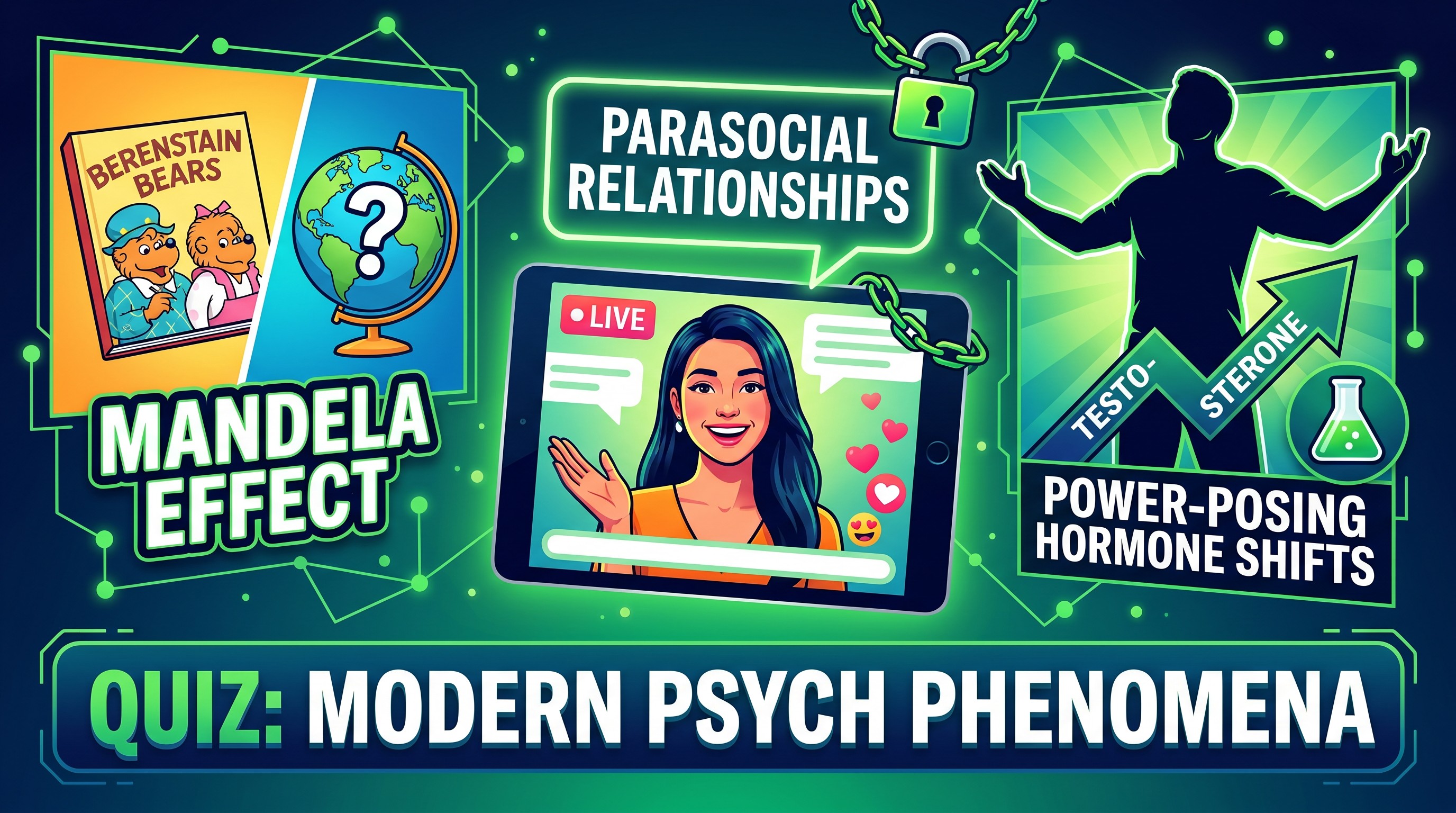
Modern Cognitive Phenomena
About this quiz
Analysis of sociocultural psychological shift
What this quiz asks
- The Mandela Effect is often characterized by a discrepancy between collective memory and historical reality. Looking at the iconic imagery of a cartoon character's attire, which element is most frequently misremembered as part of their costume, illustrating the phenomenon of Collective False Memory Dynamics?
- When analyzing Collective False Memory Dynamics, how do researchers explain the persistence of the 'Berenstain' versus 'Berenstein' spelling error despite contradictory physical evidence?
- Which cognitive mechanism best explains the rapid spread of Collective False Memory Dynamics across digital platforms, specifically regarding the 'Shazaam' movie myth?
- In the context of Collective False Memory Dynamics, what does the 'confabulation' of historical details suggest about the reliability of episodic memory?
- Parasocial attachment architecture often relies on the 'illusion of intimacy' created by consistent digital presence. In the context of Parasocial Attachment Architecture, which component primarily facilitates the viewer's perception of a reciprocal relationship despite the lack of actual interaction?
- Analyzing the Parasocial Attachment Architecture, how does the 'parasocial break' manifest when a creator alters their established digital persona or content frequency?
- In the study of Parasocial Attachment Architecture, what is the role of 'computational mirroring' in maintaining long-term engagement with digital figures?
- Evaluate the intersection of Parasocial Attachment Architecture and identity formation. When a digital figure serves as a 'parasocial mentor,' what is the primary risk to the user's psychological autonomy?
- In the context of Endocrine Feedback in Posture, which physiological state is primarily targeted by high-power posing to initiate the hypothesized shift in hormonal profiles?
- When evaluating the mechanism of Endocrine Feedback in Posture, what does the 'power-posing' hypothesis imply about the bidirectional relationship between somatic feedback and neuro-endocrine signaling?
- Critically analyze the limitations of Endocrine Feedback in Posture as applied to real-world performance; which factor most significantly complicates the replicability of these hormonal shifts in high-stakes environments?
- How does the principle of Endocrine Feedback in Posture intersect with the concept of 'embodied cognition' in a professional workplace scenario?
- In the context of Socio-Cognitive Bias Integration, how does the visual representation of overlapping memory schemas illustrate the mechanism of the Mandela Effect?
- When analyzing Socio-Cognitive Bias Integration in digital environments, what does the following visual suggest regarding the reinforcement of parasocial belief systems?
- How does the provided model of endocrine feedback loop modulation relate to the integration of power-posing and cognitive bias?
- Integrating the concepts of memory distortion and social feedback, what does this visual indicate about the susceptibility to collective cognitive biases?
- In the context of Digital Mediated Intimacy Effects, which phenomenon describes the user's perception of a reciprocal relationship with a media persona despite the lack of actual two-way interaction?
- Which technological factor significantly accelerates the 'Digital Mediated Intimacy Effects' by providing constant, curated access to a persona's daily life, thereby fostering a false sense of familiarity?
- When analyzing the 'Digital Mediated Intimacy Effects', how does the 'illusion of presence' impact the user's psychological boundary maintenance regarding public versus private information?
- Considering the integration of Digital Mediated Intimacy Effects with parasocial architecture, which psychological outcome is most likely when the persona engages in 'pseudo-conversational' content (e.g., addressing the camera directly)?
- In the study of Neuro-Hormonal Behavioral Modulation, which primary endocrine marker is typically measured to assess the physiological impact of expansive versus contractive postures?
- When analyzing the feedback loops in Neuro-Hormonal Behavioral Modulation, what is the hypothesized effect of a 'high-power' pose on the hypothalamic-pituitary-adrenal (HPA) axis?
- In the context of Neuro-Hormonal Behavioral Modulation, how does the interaction between testosterone levels and expansive posture influence risk-taking behavior in professional settings?
- How do researchers interpret the 'bidirectional' nature of Neuro-Hormonal Behavioral Modulation when evaluating the efficacy of postural intervention in high-stress environments?
Answer choices and explanations are shown when you take the quiz.
Topics
Collective False Memory DynamicsParasocial Attachment ArchitectureEndocrine Feedback in PostureSocio Cognitive Bias IntegrationDigital Mediated Intimacy EffectsNeuro Hormonal Behavioral Modulation
Make your own quiz free
Describe any idea in a sentence and Remee builds it for you — stories, games and
quizzes on whatever you or your class are working on. Free to start, no card needed,
and everything you make gets a link you can share anywhere.
Create a free accountSee it for classrooms
Quizzes on Remee
Remee quizzes come in six formats — including image questions, matching,
drag-and-drop and branching — and can be played live with up to 35 people at once,
which makes them work as easily in a classroom as they do on your own.
 Quiz
Quiz