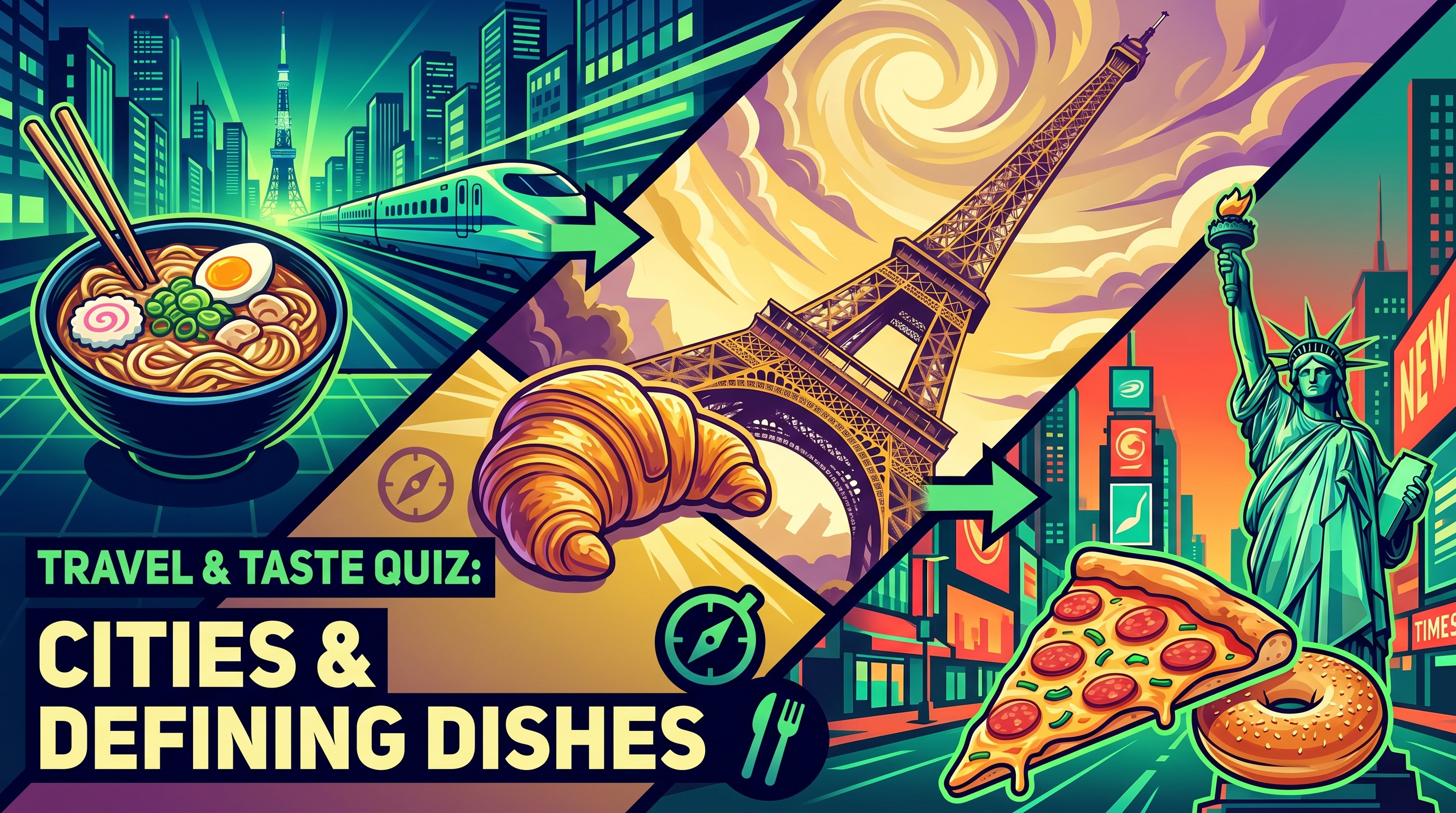
Gastronomic Urban Landscapes
About this quiz
Analyzing culinary heritage in global hubs.
What this quiz asks
- Drag the iconic dishes to their corresponding city of origin, focusing on the principle of Regional Ingredient Provenance.
- Arrange the following cities from the most 'coastal/seafood-reliant' ingredient provenance to the most 'inland/meat-reliant' provenance.
- Categorize these dishes based on the primary regional ingredient that defines their provenance: 'Alpine/Dairy-Centric' or 'Mediterranean/Olive-Centric'.
- Sequence the following cities from the most 'temperate-climate' ingredient base to the most 'tropical/humid-climate' ingredient base.
- Arrange these iconic dishes from Kyoto, Osaka, Tokyo, and Fukuoka in the order of the Traditional Culinary Technique primarily required to produce them, from simplest (minimal heat application) to most complex (multi-stage reduction or fermentation).
- Categorize these iconic global dishes based on the Traditional Culinary Technique dominant in their preparation: 'Dry Heat' versus 'Moist Heat/Braising'.
- Sequence the following traditional dough and grain preparation methods used in iconic food cities from the lowest to the highest level of mechanical and thermal processing required.
- Sort these dishes into the correct zone based on their primary Traditional Culinary Technique: 'Low-Temperature Emulsification' vs 'High-Pressure Extraction'.
- Arrange these iconic dishes from cities known for their historical fusion of trade cultures, ordered by the primary influence of the maritime spice trade on their development from least to most integrated:
- Categorize these iconic global dishes based on the primary mechanism of Cultural Exchange and Fusion that defined their current culinary identity:
- Order the following iconic urban dishes by the complexity of their ingredient provenance, from simplest mono-cultural roots to the most complex multi-continental fusion origins:
- Arrange these city-dish pairings to demonstrate the chronological progression of Cultural Exchange and Fusion, from early trade-era integration to modern globalized hybridity:
- Categorize these iconic cities based on their primary food system model: 'Export-Oriented Market' versus 'Hyper-Local Subsistence Market'.
- Arrange these cities by the historical progression of their food system infrastructure, from 'Artisanal Guild-Based Production' to 'Industrialized Globalized Logistics'.
- Rank these cities from 'Lowest' to 'Highest' reliance on imported food inputs for their iconic dishes, reflecting their degree of socio-economic food system integration.
- Align these urban food policy interventions with the Socio-Economic Food System challenges they are designed to mitigate.
- Arrange these iconic culinary cities in order of the historical development of their signature 'diaspora-influenced' dishes, from the oldest established cultural fusion to the most recent.
- Categorize the following iconic dishes based on their primary function within 'Culinary Diplomacy Strategies': classify them into 'Soft Power Branding' (used to build national image) or 'Cultural Preservation' (used to maintain heritage in diaspora).
- Rank these cities from the most formal 'Culinary Diplomacy Strategy' (centralized government-led promotion) to the most informal (grassroots, organic culinary evolution).
- Order these culinary cities by the complexity of their 'Culinary Diplomacy' impact, from the most localized economic impact to the most widespread global political influence.
- Arrange these iconic culinary cities from lowest to highest estimated 'Food Miles' impact for their signature dish ingredients, assuming a baseline import-heavy supply chain for a global tourist hub.
- Categorize the following iconic city culinary practices into their primary sustainability strategy zones: Waste Valorization or Resource Efficiency.
- Rank these cities by the historical trajectory of their culinary tourism transition: from 'Extractive Consumption' (depleting local resources for tourists) to 'Regenerative Gastronomy' (enhancing the ecosystem).
- Arrange the following stages of a 'Sustainable Gastro-Tourism Audit' in the correct logical sequence for evaluating a city's iconic dish ecosystem.
Answer choices and explanations are shown when you take the quiz.
Topics
Regional Ingredient ProvenanceTraditional Culinary TechniquesCultural Exchange and FusionSocio Economic Food SystemsCulinary Diplomacy StrategiesGastro Tourism Sustainability
Make your own quiz free
Describe any idea in a sentence and Remee builds it for you — stories, games and
quizzes on whatever you or your class are working on. Free to start, no card needed,
and everything you make gets a link you can share anywhere.
Create a free accountSee it for classrooms
Quizzes on Remee
Remee quizzes come in six formats — including image questions, matching,
drag-and-drop and branching — and can be played live with up to 35 people at once,
which makes them work as easily in a classroom as they do on your own.
 Quiz
Quiz