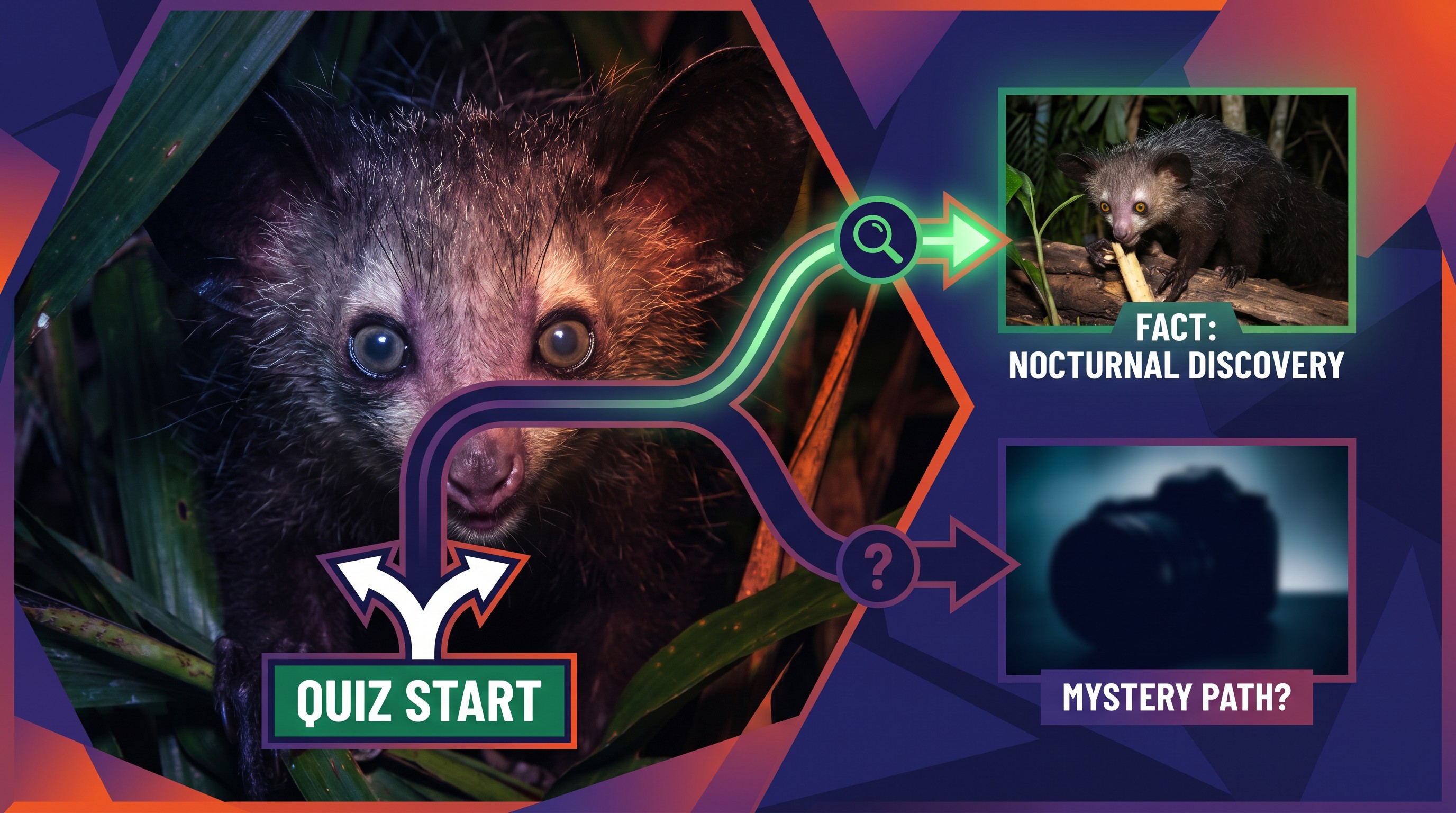
Nocturnal Wildlife Captures
About this quiz
Mastering night photography techniques
What this quiz asks
- You are tracking a rare nocturnal animal in the woods. You hear a rustle nearby. What is your first step to understand its behavior?
- You have located a rare nocturnal animal foraging. It pauses and looks directly at your camera. How do you adjust your presence?
- The animal begins a complex social interaction with another member of its species. How should you document this rare behavior?
- The animal suddenly changes its behavior from foraging to defensive posturing. What is your priority now?
- You are tracking a rare nocturnal owl. Your camera is currently set to a high aperture (f/11) to ensure depth of field. Why might this setting fail you as the sun sets?
- You are photographing a rare nocturnal creature. Your shutter speed is currently 1/30s, causing motion blur. What is the most effective adjustment to balance exposure and sharpness?
- Your night photos are coming out with excessive digital noise (grain). You are already using a wide aperture. How do you resolve this while maintaining a usable image?
- You have a rare nocturnal animal moving quickly through a dark forest. You need to balance noise, motion blur, and exposure. Which combination of settings is most professional?
- You are tracking a rare nocturnal owl. You have a powerful spotlight and a weak fill flash. How do you approach the lighting for your first shot?
- You have successfully located a nocturnal mammal. You need to choose a lighting setup that avoids the 'red-eye' effect. What is your choice?
- The rare animal is moving quickly through the underbrush. You need to balance light intensity with motion blur. Which lighting strategy do you employ?
- You are photographing a sensitive species that reacts poorly to bright light. How do you adapt your Flash and Lighting Methods to capture the shot?
- You find a perfect spot to photograph a rare nocturnal owl, but it is directly on a well-worn game trail. What is your best move for field ethics?
- You are wearing bright white gear while trying to photograph a nocturnal mammal. A fellow photographer suggests you cover it. How do you proceed?
- A rare nocturnal animal approaches your blind, but it seems nervous. What is the most ethical way to adjust your position?
- You find a nesting site of a rare nocturnal animal. How do you document this without harming the species?
- You are preparing to photograph a rare nocturnal civet in a dense forest. Which lens choice best balances the need for reach with the requirement for low-light performance?
- While tracking a nocturnal leopard, you find that your current 400mm lens is too long to frame the animal as it moves closer. What is the most effective tactical adjustment?
- You are photographing a rare nocturnal owl. You have a choice between a heavy, sharp prime lens and a lighter, slightly less sharp zoom lens. How do you decide based on the conditions?
- To capture a nocturnal mammal in its habitat, you need to combine reach, low-light capability, and depth of field control. Which setup is the most professional choice?
- You captured a grainy image of a rare nocturnal fox in low light. How should you start the Post-Processing Night Images workflow to improve visibility?
- Your nocturnal animal photo has significant digital noise from high ISO. What is the most effective approach to handle this during editing?
- You are balancing colors in a night photo where the artificial light makes the nocturnal animal look orange. What is your next move?
- Your final night image is slightly blurry but contains a rare behavior. How should you finalize the image for a scientific journal?
Answer choices and explanations are shown when you take the quiz.
Topics
Nocturnal Animal BehaviorLow Light Camera SettingsFlash and Lighting MethodsField Ethics and CamouflageLens Selection for WildlifePost Processing Night Images
Make your own quiz free
Describe any idea in a sentence and Remee builds it for you — stories, games and
quizzes on whatever you or your class are working on. Free to start, no card needed,
and everything you make gets a link you can share anywhere.
Create a free accountSee it for classrooms
Quizzes on Remee
Remee quizzes come in six formats — including image questions, matching,
drag-and-drop and branching — and can be played live with up to 35 people at once,
which makes them work as easily in a classroom as they do on your own.
 Quiz
Quiz