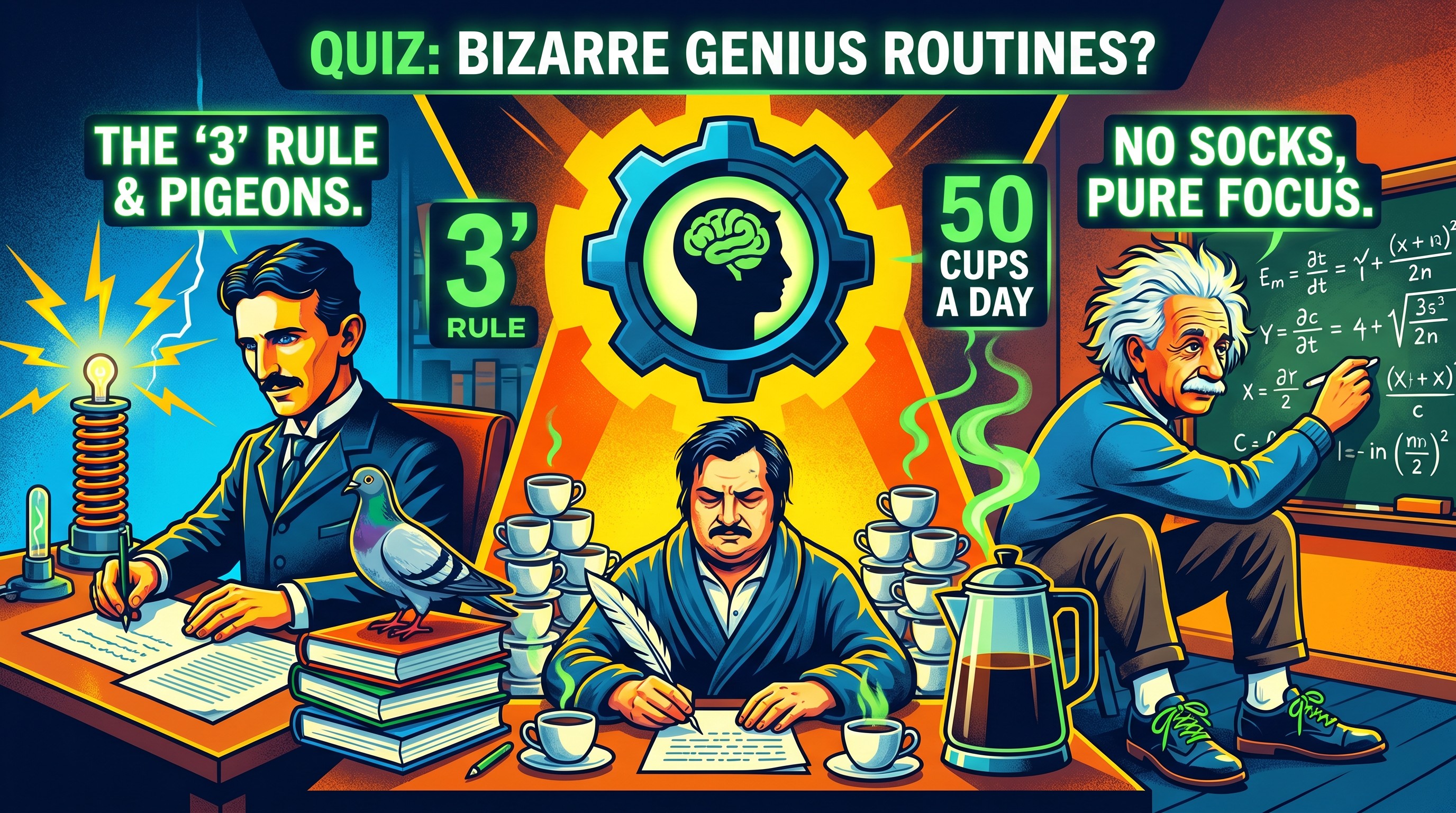
Genius Cognitive Architectures
About this quiz
Analyzing the link between habit and genius.
What this quiz asks
- Many historical figures practiced strict sleep-wake cycles aligned with solar patterns. Which physiological mechanism primarily regulates this internal timing system, often disrupted by artificial light?
- Historical geniuses often utilized 'crepuscular' work schedules. When analyzing the efficacy of such routines, which hormone's secretion profile acts as the primary biomarker for Circadian Rhythm Optimization?
- When evaluating the work-rest cycles of polymaths who favored shifting their sleep windows, which phenomenon describes the misalignment between the internal biological clock and the social/professional schedule?
- In professional environments, how does the manipulation of blue-light exposure affect the synthesis of neuro-modulators relevant to Circadian Rhythm Optimization in the context of high-intensity cognitive labor?
- When evaluating the Uberman sleep schedule—a polyphasic pattern involving six 20-minute naps—which physiological state represents the primary risk factor for cognitive impairment in high-functioning professionals?
- Analyzing the historical accounts of Leonardo da Vinci’s alleged use of the Everyman sleep cycle, how does the transition between ultradian rhythms impact long-term creative output?
- When comparing Nikola Tesla's irregular rest periods to modern biphasic models, which metabolic consequence is most associated with the failure to complete a full sleep cycle?
- An architect of high-performance work routines attempts to integrate Polyphasic Sleep Patterns with existing circadian entrainment. Which variable must be prioritized to prevent complete autonomic nervous system dysregulation?
- When analyzing the work routine of Nikola Tesla, which aspect of cognitive load distribution explains his method of mentally simulating complex mechanical prototypes before physical construction?
- During the writing process, Ernest Hemingway famously utilized a 'standing desk' technique. In terms of Cognitive Load Distribution, how does this physiological shift impact executive function?
- Consider the 'incubation' periods of mathematicians like Henri Poincaré. Which mechanism of Cognitive Load Distribution describes the shifting of a complex problem from the conscious working memory to the background processing of the subconscious?
- When integrating multiple creative tasks, how does the concept of Cognitive Load Distribution explain the efficacy of switching between high-intensity analytical work and low-intensity manual tasks?
- Which environmental stimuli modulation technique did Nikola Tesla famously employ by strictly controlling his workspace light levels and acoustic surroundings to induce a hypnagogic state?
- When considering the work habits of writers like Victor Hugo, how does the deliberate modulation of environmental stimuli, such as working in a barren room or on a rooftop, impact cognitive throughput?
- The 'bizarre' habit of Igor Stravinsky standing on his head to clear his mind represents which aspect of environmental stimuli modulation through physiological state change?
- Evaluate the efficacy of modulating environmental stimuli through 'scent-anchoring' (a technique used by Schiller with rotting apples). How does this modulate the cognitive environment for creative production?
- When considering the Flow State Neurobiology of geniuses like Nikola Tesla, which transient hypofrontality phenomenon best describes the mechanism by which they achieved deep, uninterrupted focus during their intensive work sessions?
- Many polymaths utilized specific environmental cues to enter flow states. From a neurobiological perspective, how does the modulation of environmental stimuli influence the release of neurochemicals like norepinephrine and dopamine in the brain?
- Analyze the relationship between the 'Challenge-Skill Balance' and the neurobiological markers of flow. What occurs when the task complexity significantly exceeds the individual's skill level, effectively breaking the flow state?
- By synthesizing the concepts of creative incubation and flow state neurobiology, how does the 'incubation period' of a genius's work routine actually serve to prime the brain for subsequent deep-work flow?
- Salvador Dalí utilized the hypnagogic state to fuel his surrealist imagery. Based on the visual of a falling key, which Creative Incubation Heuristic describes this deliberate entry into the threshold of sleep to capture dream-like insights?
- Many thinkers, such as Poincaré, emphasized the necessity of a 'conscious break' during complex problem-solving. Observing the visual representation of a dormant phase following intense focus, which phase of Creative Incubation Heuristics is being depicted?
- When applying Creative Incubation Heuristics to professional workflows, how does the 'diffusion of focus' illustrated by the scattering geometric shapes function to enhance innovation compared to sustained concentration?
- In the context of Creative Incubation Heuristics, analyze the visual of a dual-state system. Which mechanism explains how shifting between the 'incubation' and 'active' states optimizes the resolution of highly complex, ill-defined problems?
Answer choices and explanations are shown when you take the quiz.
Topics
Circadian Rhythm OptimizationPolyphasic Sleep PatternsCognitive Load DistributionEnvironmental Stimuli ModulationFlow State NeurobiologyCreative Incubation Heuristics
Make your own quiz free
Describe any idea in a sentence and Remee builds it for you — stories, games and
quizzes on whatever you or your class are working on. Free to start, no card needed,
and everything you make gets a link you can share anywhere.
Create a free accountSee it for classrooms
Quizzes on Remee
Remee quizzes come in six formats — including image questions, matching,
drag-and-drop and branching — and can be played live with up to 35 people at once,
which makes them work as easily in a classroom as they do on your own.
 Quiz
Quiz