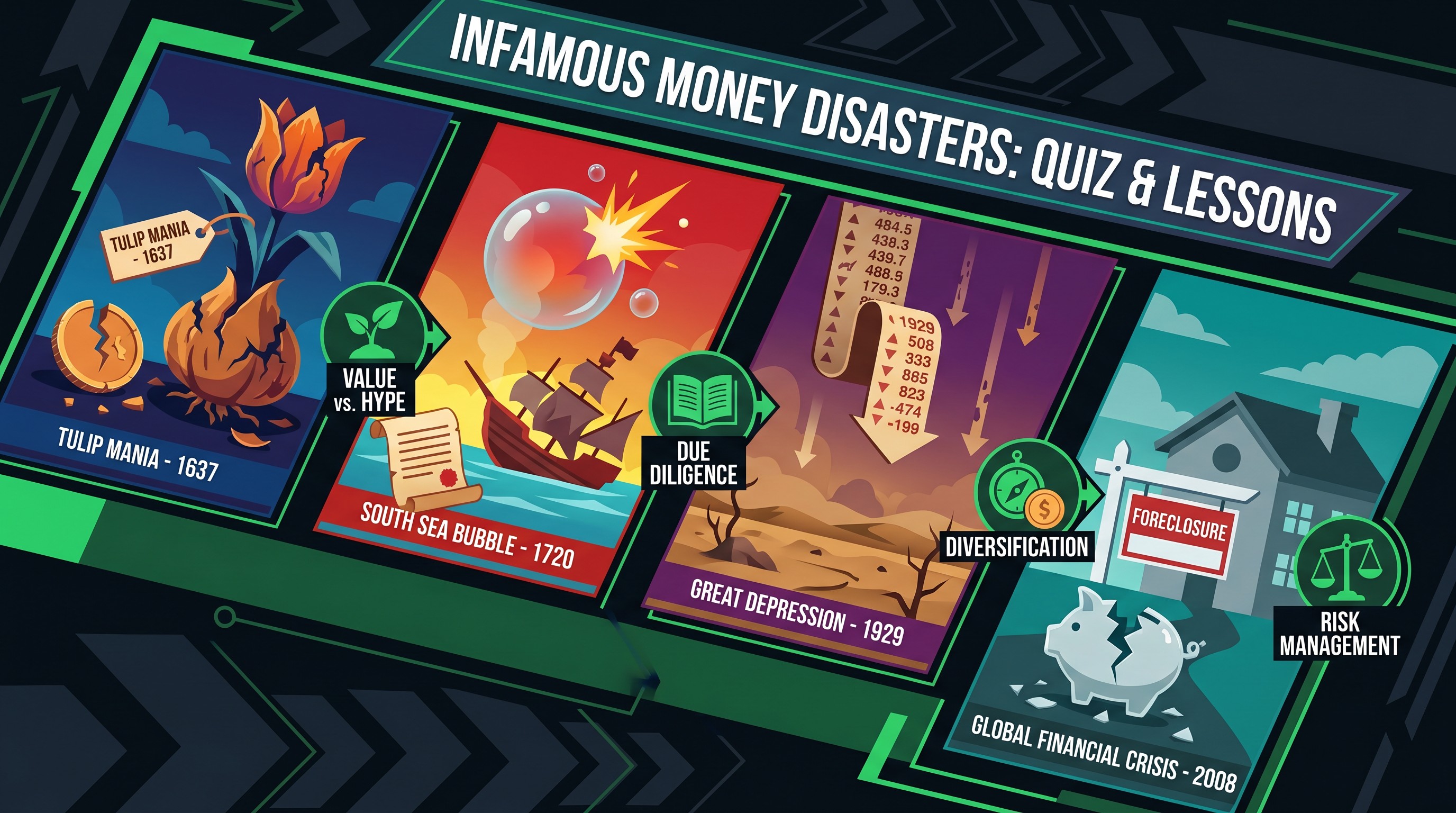
Fiscal Catastrophes Analysed
About this quiz
Lessons from systemic economic failures.
What this quiz asks
- Arrange these stages of a Speculative Asset Bubble in the standard chronological order from initial inception to final collapse.
- Categorize these historical financial events by the primary underlying catalyst that drove their respective Speculative Asset Bubbles.
- Rank these indicators of a maturing Speculative Asset Bubble from the most subtle 'early warning' to the most 'evident sign' of market overheating.
- Sequence these reactive policy measures from the most appropriate 'preventative' action to the most 'drastic intervention' used during a burst Speculative Asset Bubble.
- Order the following phases of a classic Sovereign Debt Default Mechanism from the initial onset of fiscal distress to the final resolution stage.
- Categorize the following characteristics of Sovereign Debt Default Mechanisms based on whether they pertain to the 'Economic Causes' or 'Resolution Strategies' of a sovereign crisis.
- Arrange these instruments and entities involved in Sovereign Debt Default Mechanisms from the most senior (least risk of haircut) to the most junior (highest risk of loss in restructuring).
- Sequence the following procedural steps in a modern sovereign debt workout as defined by standard Sovereign Debt Default Mechanisms.
- Regulatory arbitrage often follows a predictable lifecycle when institutions exploit loopholes. Arrange these stages of the regulatory arbitrage cycle in the logical order of progression from initiation to eventual correction.
- Classify the following financial activities based on whether they primarily function as legitimate optimization or as high-risk Regulatory Arbitrage Failures.
- Rank these historical and structural scenarios by the degree of systemic threat posed by their Regulatory Arbitrage Failures, from lowest to highest potential for catastrophic contagion.
- Arrange the following steps for an effective macroprudential response to mitigate Regulatory Arbitrage Failures, from initial detection to systemic hardening.
- Categorize the following liquidity crisis indicators into 'Early Warning Signals' or 'Advanced Systemic Contagion' phases as observed in historical financial collapses.
- Arrange these stages of a liquidity-driven market collapse in the correct chronological order of progression, from initial localized distress to global systemic failure.
- Sort the following risk management failures into their primary categories: 'Structural Vulnerabilities' or 'Behavioral Feedback Loops' that exacerbate Liquidity Crisis Contagion.
- Sequence the following policy interventions in the order they are typically deployed to mitigate Liquidity Crisis Contagion, from immediate stop-gap measures to structural stabilization.
- Arrange the following stages of an algorithmic feedback loop leading to a flash crash in the order they typically occur, starting from the initial trigger.
- Categorize these algorithmic trading strategies based on their typical impact on market stability during high-volatility events, from most stabilizing to most destabilizing.
- Sequence the following risk management protocols in the order they should be implemented to mitigate the impact of runaway algorithmic trading volatility.
- Arrange these factors from the most immediate to the most structural contributor to algorithmic trading volatility in modern financial markets.
- Arrange these macroprudential policy instruments from the most focused on individual bank risk (micro-level) to the most focused on systemic financial stability (macro-level).
- Order the following stages of a financial crisis response using macroprudential tools, from the initial detection of imbalances to the final mitigation of contagion.
- Rank these macroprudential measures by their typical impact on market liquidity, from the most restrictive (lowest liquidity) to the least restrictive (highest liquidity).
- Arrange the following historical lessons of financial disasters in the order they should be integrated into a robust Macroprudential Policy Efficacy framework, from foundational structural reform to dynamic operational response.
Answer choices and explanations are shown when you take the quiz.
Topics
Speculative Asset BubblesSovereign Debt Default MechanismsRegulatory Arbitrage FailuresLiquidity Crisis ContagionAlgorithmic Trading VolatilityMacroprudential Policy Efficacy
Make your own quiz free
Describe any idea in a sentence and Remee builds it for you — stories, games and
quizzes on whatever you or your class are working on. Free to start, no card needed,
and everything you make gets a link you can share anywhere.
Create a free accountSee it for classrooms
Quizzes on Remee
Remee quizzes come in six formats — including image questions, matching,
drag-and-drop and branching — and can be played live with up to 35 people at once,
which makes them work as easily in a classroom as they do on your own.
 Quiz
Quiz