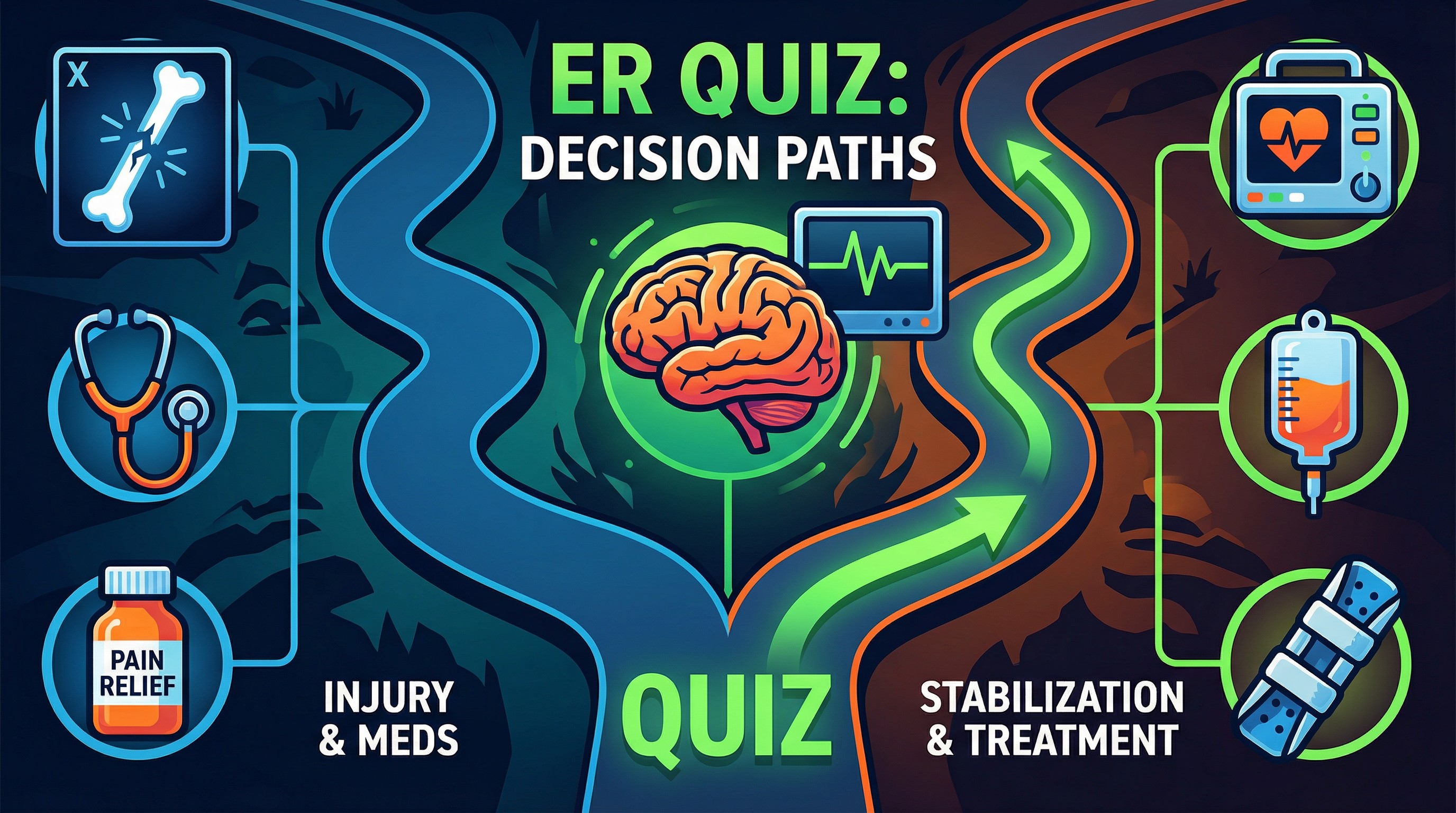
Emergency Care Essentials
About this quiz
Mastering ER stabilization and treatment.
What this quiz asks
- An ambulance arrives at the emergency room with a patient who is unconscious but breathing. As the triage nurse, what is your first priority in Triage and Assessment?
- You are managing three patients in the emergency room: one with a minor cut, one with severe chest pain, and one with a sprained ankle. Using Triage and Assessment principles, who do you treat first?
- A patient arrives complaining of a sudden, high fever and confusion. How should you proceed with Triage and Assessment?
- A patient arrives with multiple injuries from a bicycle accident. They are alert but in significant pain. How do you balance Triage and Assessment with the need for pain management?
- A patient arrives at the ER feeling dizzy. You need to perform Vital Signs Monitoring to establish a baseline. What is your first step?
- During Vital Signs Monitoring, you notice a patient's oxygen saturation is dropping below 90%. How do you proceed?
- You are monitoring a patient who has been injured in a fall. Their heart rate is increasing while their blood pressure is decreasing. What does this indicate for your Vital Signs Monitoring strategy?
- A patient with a high fever is being stabilized. How should you integrate Vital Signs Monitoring into their overall emergency care?
- A patient arrives with a deep laceration on their forearm that is bleeding steadily. What is your first priority in trauma stabilization?
- A patient arrives with a suspected broken leg after a fall. How do you approach the stabilization of the limb?
- You are treating a patient with a suspected neck injury from a sports collision. What is the most critical step for stabilization?
- A patient presents with a suspected pelvic fracture and signs of shock. How do you prioritize their stabilization?
- A patient arrives with a severe allergic reaction. You need to administer epinephrine. What is your first priority in this emergency pharmacology situation?
- You are preparing a pain medication for a patient. You have two options: a liquid form that works quickly or a pill that takes longer. The patient is in extreme distress. Which do you choose?
- A patient is prescribed a new medication, but they have a known allergy to a similar drug class. How should you handle this emergency pharmacology challenge?
- You notice that two medications being prepared for a patient might interact negatively. What is the most responsible action to take?
- A patient arrives with a deep laceration and a history of exposure to an unknown environmental pathogen. What is your primary action for Infectious Disease Control?
- You are treating a patient with a suspected highly contagious respiratory virus. Which isolation strategy is most effective for Infectious Disease Control in the ER?
- A patient presents with symptoms of a severe systemic infection. You must decide on the order of operations for stabilization and Infectious Disease Control. What do you do first?
- You are managing a trauma patient who also has a known multi-drug resistant organism. How should you coordinate their care for optimal Infectious Disease Control?
- A patient arrives with a deep laceration on their forearm that is bleeding steadily. What is your first priority in Fracture and Wound Management?
- A patient presents with a limb that is visibly deformed after a fall. What is the correct protocol for Fracture and Wound Management before imaging?
- You are treating a patient with a compound fracture where the bone has broken through the skin. How do you balance priorities in Fracture and Wound Management?
- A patient has a deep puncture wound from a rusty object. Beyond initial cleaning, what is the critical step for long-term Fracture and Wound Management?
Answer choices and explanations are shown when you take the quiz.
Topics
Triage and AssessmentVital Signs MonitoringTrauma StabilizationEmergency PharmacologyInfectious Disease ControlFracture and Wound Management
Make your own quiz free
Describe any idea in a sentence and Remee builds it for you — stories, games and
quizzes on whatever you or your class are working on. Free to start, no card needed,
and everything you make gets a link you can share anywhere.
Create a free accountSee it for classrooms
Quizzes on Remee
Remee quizzes come in six formats — including image questions, matching,
drag-and-drop and branching — and can be played live with up to 35 people at once,
which makes them work as easily in a classroom as they do on your own.
 Quiz
Quiz